“Viksit Bharat 2047” is India’s dream of becoming a developed country by 2047, which is undoubtedly the most ambitious vision for the country’s transformation since Independence. In the past, the growth of India was driven by a few metropolitan cities, Mumbai, Delhi, Bengaluru, Chennai, Hyderabad, Pune, and Kolkata. These cities attracted investment, talent, infrastructure and jobs. But a subtle shift is taking place now. India’s future growth story could well be in Tier-2 and Tier-3 cities rather than its metros. The single question that is now on the minds of the policymakers, economists and investors is ‘Can Bharat (smaller cities and emerging urban centers) be the true driver of Viksit Bharat?
The solution could be the key to India’s goal of becoming a developed nation by the 100th anniversary of independence. The rate of urbanisation in India is unprecedented. World Bank projections predict that by 2036 nearly 600 million people will be living in urban areas, around 40% of the country’s population. These urban centres already account for nearly 70% of the country’s GDP. The success of this urban transition will have a profound impact on India’s development trajectory towards 2047. Economic growth has been focussed in metropolitan India for many years. But the congestion, the skyrocketing property values, pollution, and infrastructure strain are compelling enterprises and citizens to seek alternatives to the traditional urban sites. At the same time, better roads, information technology, airports, industrial corridors and government infrastructure initiatives are making it more appealing to live in smaller cities. Investment and employment hub cities like Indore, Surat, Coimbatore, Bhubaneswar, Lucknow, Jaipur, Kochi, Nagpur, Visakhapatnam, Chandigarh and Raipur are quickly transforming. Lower operating costs, affordable housing, a growing talent pool, and a better quality of life are some of the advantages these cities have over many metropolitan regions.
The growth of Tier-2 and Tier-3 cities is not a demographic phenomenon, but an economic one as well. One of the main reasons for this change is the price. The cost of living in smaller cities is still much less expensive than in metropolitan India. There are many cities like Indore, Lucknow, Coimbatore where the prices of houses are not so high as that of Mumbai or Bengaluru. These cities offer opportunities to middle class families to own homes, get good education, and live a better life without the burden of a big city. These benefits are also becoming apparent to businesses. Traditionally, Global Capability Centres are dominated by cities like Bengaluru, Hyderabad and Pune, and are now increasingly moving to cities like Jaipur, Kochi, Ahmedabad, Coimbatore and Chandigarh. These areas are becoming popular destinations for international companies thanks to the availability of skilled people and the low operating costs.
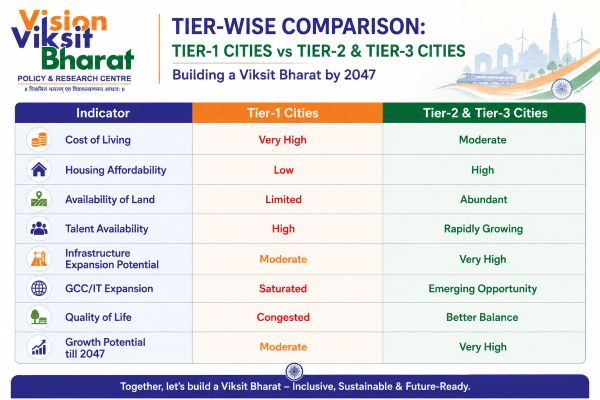
Sources: World Bank Urbanization Report, NITI Aayog Vision Documents, Economic Survey 2025-26, Invest India, PIB releases.
Another important factor is infrastructure development. India has been investing in expressways, modernization of airports, railways, digital infrastructure and logistics over the past decade. The distance between smaller cities and major economic hubs has been shortened with projects like the Delhi-Mumbai Industrial corridor, Bharatmala, Dedicated Freight Corridors, and regional airport expansion. This is also reflected in policy dialogues, as the government places greater importance on Tier-2 and Tier-3 cities. Prime Minister Narendra Modi has time and again emphasised the importance of smaller cities acting as new growth centres of the Indian Economy. Likewise, NITI Aayog has emphasised on sustainable urban planning, skill development, and infrastructure development in newly developing urban centres. This has been further speeded up by technology. The young do not have to leave rural areas to join the modern economy as they did in the past. The economic disadvantages of smaller cities have been diminished by remote working, digital commerce, fintech platforms, online education, telemedicine and digital public infrastructure. The success of Unified Payments Interface (UPI), cheap Internet connectivity, and smart phone penetration has helped Bharat’s entrepreneurs gain access to national and global markets.
A start-up from Indore or Bhubaneswar today can cater to the needs of people all over the world. The digital democratization of opportunity is one of the most robust ones that underpin the growth of Bharat. This is reflected in the real estate industry as well. Housing affordability is a problem in metro areas, but Tier-2 cities remain popular destinations for home buyers and investors. According to industry reports, the demand in smaller cities is getting higher because of the improved connectivity, higher employment opportunities, and lower acquisition costs. This is contributing to the development of local ecosystems of consumption, investment and entrepreneurship. The education system is also changing. City-based institutions like Prayagraj, Indore, Mysuru and Bhubaneswar are seeing a rise in the number of multidisciplinary degree courses and industry-oriented curricula. This is helping to diminish the reliance on the historical “educational hubs” that are based in the metro area and allowing for local talent to develop.
However, the rise of Bharat is not without challenges
In many Tier-2 and Tier-3 cities, urban governance remains weak, municipal finances are inadequate, public transport systems are not robust and healthcare facilities are lacking. Larger metros have encountered problems with water supply, waste disposal, air pollution and unplanned urban growth that are likely to be repeated here. Experts believe that to attain the goals of Viksit Bharat, urban governance reforms will be necessary. The cities must be more financially independent, have stronger local institutions, have a better planning capacity and have more citizen involvement in order to effectively manage future growth.
Skill development is also a key challenge. Despite the number of graduates being produced by smaller cities, there are still more industries reporting a lack of job-ready graduates. This will need increased partnership between education, industry and government. Another topic that is not to be ignored involves climate resilience. Urban populations will grow and put pressure on water resource, energy systems, transportation systems and environmental sustainability. The need to address climate adaptation issues in urban planning from the beginning is clear for India to prevent future crises.
Yet despite these challenges, the broader direction is clear
In many countries, economic development has been concentrated in a few big cities, before trickling down to secondary cities. It looks like India is moving towards this second phase. The supremacy of a few metropolitan cities is slowly being replaced by a more diversified model of development in which smaller cities have a bigger role in the development of the country. The vision of Viksit Bharat 2047 cannot be realised through a few megacities alone.A few megacities cannot meet the requirements of the vision of Viksit Bharat 2047. The nation requires hundreds of vibrant, bustling cities that can create jobs, draw investments, encourage innovation and enhance the quality of life. The future of India may not be defined by Mumbai, Delhi, Bengaluru, but perhaps by Indore, Surat, Lucknow, Coimbatore, Bhubaneswar, Nagpur, Kochi, and Visakhapatnam.
The story of Viksit Bharat will thus not be about India vs Bharat. It will be about Bharat being the strongest of the Indian strengths. Tier-2 and Tier-3 cities are no longer the supporting actors in India’s growth story as the nation heads towards 2047. They are now playing a more dominant role as the primary scene where the next chapter in India’s development can be written. With proper policies, investments and governance reforms, Bharat can very well become the Viksit Bharat which India aspires to be.
