“Infrastructure is not merely about building roads; it is about building markets, mobility, productivity and national confidence.”
Over the the last twelve years, India has undertaken one of the most ambitious infrastructure transformations witnessed by any major economy in the twenty-first century. Under the leadership of Prime Minister Shri Narendra Modi and the stewardship of Union Minister for Road Transport and Highways Shri Nitin Gadkari, India’s highway sector has transitioned from incremental expansion to strategic nation-building, fundamentally altering the country’s economic geography, logistics ecosystem and developmental trajectory.
This transformation extends beyond the construction of roads and expressways. It represents a structural shift in governance philosophy—viewing infrastructure as an instrument of economic competitiveness, regional integration, national security and social inclusion. Between 2014 and 2026, India not only expanded its highway network at unprecedented speed but also developed a new institutional architecture that combines scale, technology, financing innovation and execution efficiency.
As India advances toward the vision of Viksit Bharat, the country’s road infrastructure revolution offers important lessons in state capacity, public investment strategy and infrastructure-led growth.
Infrastructure as an Engine of Economic Transformation
Economic literature has long established a strong relationship between transportation infrastructure and economic growth. Studies by the World Bank, Asian Development Bank and OECD indicate that every 1 percent increase in public infrastructure investment can generate long-term GDP gains ranging between 1.5 and 2.5 percent through multiplier effects.
For India, the challenge was particularly acute. Prior to 2014, high logistics costs, estimated at 13–14 percent of GDP compared to 8–9 percent in developed economies, reduced industrial competitiveness and constrained economic integration. The response was a paradigm shift: moving from isolated road projects to integrated economic corridor development.
The results have been remarkable:
- National Highway network expanded by over 61 percent.
- Highway construction speed nearly tripled.
- Multiple access-controlled expressways transformed inter-city mobility.
- Logistics efficiency improved significantly.
- Regional disparities in connectivity began narrowing.
This transformation has positioned transportation infrastructure as one of the principal drivers of India’s economic expansion.
Bharatmala Pariyojana: Reimagining India’s Economic Geography
Among the most transformative initiatives undertaken by the Government of India is the Bharatmala Pariyojana, approved in 2017 with an estimated investment of ₹5.35 lakh crore. Unlike conventional road-building programmes, Bharatmala was conceptualized as an integrated economic connectivity framework designed to optimize freight movement and reduce logistics costs across the national economy.
The programme envisages the development of 34,800 km of strategic highway corridors, including:
- Economic Corridors
- Inter-Corridor and Feeder Routes
- National Corridor Efficiency Projects
- Border Roads
- Coastal Roads
- Port Connectivity Projects
- Greenfield Expressways
As of March 2026:
| Indicator | Achievement |
|---|---|
| Planned Network | 34,800 km |
| Projects Awarded | 26,425 km |
| Projects Constructed | 22,590 km |
| Estimated Investment | ₹5.35 lakh crore |
The significance of Bharatmala lies in its strategic approach to infrastructure planning. Rather than merely connecting cities, it seeks to connect economic activity centres, manufacturing clusters, ports, logistics hubs and consumption markets. This approach aligns with global evidence demonstrating that corridor-based infrastructure investments generate significantly higher economic returns than fragmented transport projects.
The Great Expansion: India’s National Highway Network
The expansion of India’s National Highway network during the last decade represents one of the largest infrastructure scaling exercises undertaken by any democratic nation. From approximately 91,287 kilometres in 2014, the network expanded to over 146,572 kilometres by FY 2025–26, an increase of nearly 61 percent. This expansion has produced multiple developmental outcomes:
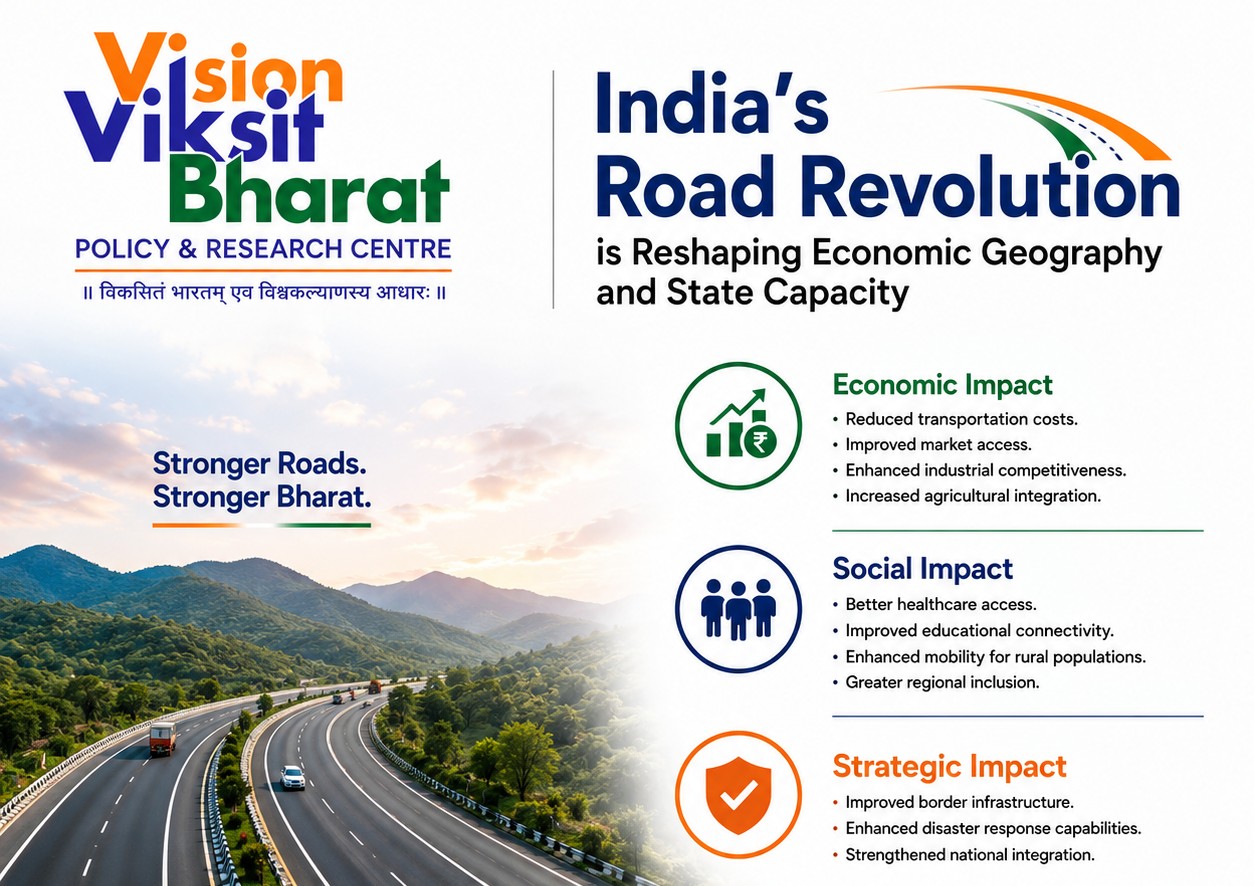
Economic Impact
- Reduced transportation costs.
- Improved market access.
- Enhanced industrial competitiveness.
- Increased agricultural integration.
Social Impact
- Better healthcare access.
- Improved educational connectivity.
- Enhanced mobility for rural populations.
- Greater regional inclusion.
Strategic Impact
- Improved border infrastructure.
- Enhanced disaster response capabilities.
- Strengthened national integration.
By connecting previously underserved regions with economic growth centres, highway expansion has become an important instrument for reducing regional disparities.
From 11 km to 34 km Per Day: Building State Capacity
Perhaps the most remarkable achievement of India’s highway transformation has been the dramatic increase in construction speed.
| Year | Construction Pace |
|---|---|
| 2013–14 | 11.6 km/day |
| 2025–26 | Nearly 34 km/day |
This threefold increase reflects not merely higher expenditure but a fundamental improvement in governance and implementation capacity.
Several reforms contributed to this achievement:
- Digital project monitoring systems
- Faster land acquisition mechanisms
- Hybrid Annuity financing models
- Institutional strengthening of NHAI
- Greater private sector participation
- Adoption of advanced construction technologies
A study conducted by the Indian Institute of Management Bangalore found that improved highway connectivity significantly reduced transportation costs between factories, suppliers and consumers, thereby enhancing industrial productivity and competitiveness.
The expansion of highway infrastructure has therefore become not merely a transportation success but a case study in institutional reform and state capability enhancement.
Delhi–Mumbai Expressway: India’s Economic Super Corridor
The Delhi–Mumbai Expressway, spanning approximately 1,386 kilometres, represents India’s most ambitious expressway project to date.
Developed at an estimated cost of nearly ₹1 lakh crore, the expressway connects six major states:
- Delhi
- Haryana
- Rajasthan
- Madhya Pradesh
- Gujarat
- Maharashtra
The corridor is expected to:
- Reduce travel time by almost 50 percent.
- Lower logistics costs.
- Generate industrial clusters.
- Promote manufacturing investment.
- Create employment opportunities.
- Accelerate urbanization along growth corridors.
Economists increasingly view mega-corridors such as the Delhi–Mumbai Expressway as instruments for reshaping national economic geography, similar to the impact of interstate highways in the United States and high-speed logistics corridors in East Asia.
Delhi–Meerut Expressway: The Economics of Regional Mobility
The Delhi–Meerut Expressway, developed at a cost of approximately ₹8,346 crore, demonstrates how high-quality regional infrastructure can transform urban ecosystems.
The 82-km corridor has:
- Reduced travel time dramatically.
- Lowered congestion in the National Capital Region.
- Increased economic integration.
- Improved commuting efficiency.
- Stimulated real estate and industrial development.
The project illustrates the growing importance of metropolitan connectivity infrastructure in supporting India’s urban transition.
Dwarka Expressway: Building the Future of Urban Transport
The Dwarka Expressway, developed at nearly ₹9,000 crore, represents a new generation of urban infrastructure characterized by:
- Multi-level transportation systems
- Intelligent traffic management
- Advanced engineering design
- Access-controlled mobility
By improving connectivity between Delhi and Gurugram, the expressway addresses one of India’s most pressing development challenges: urban congestion and productivity loss. According to various estimates, traffic congestion costs India between 4 and 8 percent of GDP annually. Investments in urban mobility corridors therefore represent both transportation policy and economic policy.
Bengaluru–Mysuru Expressway: Infrastructure as a Regional Growth Multiplier
The Bengaluru–Mysuru Expressway, inaugurated in March 2023, demonstrates how strategic infrastructure can transform regional economies. Developed at a cost of ₹8,480 crore, the 118-km corridor reduced travel time from approximately three hours to just 75 minutes.
Its impact extends beyond transportation:
- Increased tourism flows.
- Enhanced industrial connectivity.
- Improved logistics efficiency.
- Expanded labour market integration.
- Accelerated regional investment.
The corridor reflects the global experience that reducing travel time effectively expands economic geography and productivity.
Delhi–Dehradun Economic Corridor: Towards Sustainable Infrastructure Development
Perhaps the most significant evolution in India’s highway strategy has been the integration of environmental sustainability into infrastructure design.
The Delhi–Dehradun Economic Corridor, inaugurated in April 2026, represents this transition.
Developed at a cost of approximately ₹12,000 crore, the 213-km corridor:
- Reduces travel time from over six hours to approximately 2.5 hours.
- Incorporates one of Asia’s longest elevated wildlife corridors.
- Includes environmentally sensitive engineering solutions.
- Demonstrates coexistence between development and ecological conservation.
The project signals a broader policy shift toward sustainable infrastructure development and climate-sensitive engineering practices.
Beyond Roads: Building India’s Logistics Competitiveness
The true significance of India’s highway revolution lies not in kilometres constructed but in the creation of an integrated logistics ecosystem.
High-quality road infrastructure directly supports:
- The National Logistics Policy.
- PM Gati Shakti.
- Manufacturing competitiveness.
- Export growth.
- Supply chain resilience.
- Regional industrialization.
As India’s economy moves toward the $10 trillion aspiration, reducing logistics costs from approximately 13–14 percent of GDP to single digits will become essential for maintaining competitiveness. Infrastructure investment, therefore, is increasingly becoming industrial policy by other means.
Policy Challenges for the Next Decade
1. Road Safety: India’s Greatest Infrastructure Challenge
While India has built one of the world’s fastest-expanding highway networks, road safety remains a major concern. According to the Ministry of Road Transport and Highways’ Road Accidents in India 2023 report, India recorded over 4.8 lakh road accidents, resulting in approximately 1.72 lakh fatalities, making it one of the countries with the highest road accident deaths globally. Nearly 60% of fatalities occur among individuals aged 18–45 years, representing a significant loss of productive human capital. The World Bank estimates that road crashes cost India around 3–5% of its GDP annually, amounting to economic losses exceeding ₹8–10 lakh crore every year. Despite national highways constituting only about 2% of the road network, they account for a disproportionately high share of fatal accidents due to higher speeds and traffic volumes.
Addressing this challenge requires a paradigm shift from road construction to a comprehensive “safe systems approach.” The government has initiated measures such as the identification of over 13,000 accident black spots, implementation of the Motor Vehicles (Amendment) Act, 2019, and mandatory road safety audits for national highway projects. However, future policy must prioritize intelligent speed enforcement, AI-enabled traffic monitoring, advanced driver assistance systems, emergency trauma care networks, and integrated road-user education. Achieving the target of reducing road fatalities by 50% by 2030, aligned with the UN Decade of Action for Road Safety, will require sustained investment, stronger institutional coordination, and technological innovation.
2. Sustainable Financing: Beyond Traditional Public Spending
India’s infrastructure ambitions under the PM Gati Shakti National Master Plan and the vision of a developed nation by 2047 require unprecedented financial resources. The government has estimated infrastructure investments exceeding ₹143 lakh crore under the National Infrastructure Pipeline (NIP), with roads accounting for one of the largest shares. While budgetary allocations for the Ministry of Road Transport and Highways have increased substantially—from approximately ₹33,000 crore in 2013–14 to over ₹3 lakh crore in 2025–26—public finances alone cannot sustain the scale of future infrastructure expansion. Rising fiscal pressures and competing social sector expenditures necessitate diversified financing mechanisms.
The next decade will therefore require a transition toward innovative financing models. Instruments such as Infrastructure Investment Trusts (InvITs), Toll-Operate-Transfer (TOT) models, green bonds, municipal bonds, sovereign infrastructure funds, and public-private partnerships (PPPs) will play a crucial role. The National Highways Authority of India (NHAI) has already demonstrated success by monetizing highway assets through InvITs and TOT bundles, raising tens of thousands of crores for reinvestment. Future strategies could also include climate finance mechanisms, pension fund investments, and blended finance models that combine public and private capital. Building a sustainable financing ecosystem will be critical to ensuring that infrastructure expansion remains fiscally responsible while supporting long-term economic growth.
3. Climate Resilience: Building Highways for a Changing Climate
Climate change poses a growing threat to transportation infrastructure worldwide, and India’s highways are increasingly vulnerable to extreme weather events. According to the Intergovernmental Panel on Climate Change (IPCC) and various domestic assessments, India is experiencing more frequent floods, heatwaves, cyclones, landslides, and extreme rainfall events. In recent years, several highway corridors in the Himalayan region, northeastern states, and coastal areas have suffered extensive damage due to climate-related disasters, resulting in substantial economic losses and disruptions to supply chains. The vulnerability of transport infrastructure threatens not only mobility but also national economic resilience.
Future highway development must therefore integrate climate adaptation and resilience at every stage of planning and execution. This includes adopting climate-resilient engineering standards, strengthening drainage systems, using heat-resistant pavement materials, constructing elevated corridors in flood-prone regions, and incorporating nature-based solutions for slope stabilization and erosion control. The government has already begun integrating sustainability measures through green highways initiatives, use of recycled materials, and carbon reduction strategies. However, achieving climate-resilient infrastructure at scale will require dedicated financing frameworks, climate risk assessments, advanced geospatial monitoring systems, and close coordination between environmental and infrastructure agencies.
4. Asset Maintenance: From Construction to Lifecycle Management
India’s rapid expansion of highways has created an equally significant challenge: maintaining an increasingly vast and complex road asset base. The country now possesses more than 1.46 lakh kilometers of National Highways, compared to approximately 91,000 kilometers in 2014, while the overall road network exceeds 6.7 million kilometers, making it one of the largest in the world. As infrastructure assets mature, maintenance expenditures will inevitably rise. International experience demonstrates that inadequate maintenance often leads to exponentially higher reconstruction costs, reduced road safety, and lower economic efficiency.
The next phase of India’s road sector transformation must prioritize asset lifecycle management rather than focusing exclusively on new construction. This requires expanding performance-based maintenance contracts, introducing digital asset management systems, deploying drones and IoT-based monitoring technologies, and establishing dedicated maintenance financing mechanisms. Predictive maintenance enabled by artificial intelligence can significantly reduce costs and improve asset longevity. Additionally, the development of a comprehensive national road asset registry and condition monitoring framework can support evidence-based investment decisions. Sustaining the quality and functionality of India’s highway network will ultimately determine the long-term returns on the country’s infrastructure investments.
5. Technology Integration: Building Smart and Connected Highways
The future of transportation infrastructure will be defined not merely by physical connectivity but by digital intelligence. India has already made substantial progress through initiatives such as FASTag, which has transformed toll collection by enabling over 98% electronic tolling penetration on national highways. Similarly, the government’s investment in digital public infrastructure and geospatial technologies under PM Gati Shakti has laid the foundation for integrated transport planning. However, India’s highway system remains in the early stages of adopting advanced intelligent transportation technologies.
Over the next decade, highways will need to evolve into smart mobility corridors equipped with artificial intelligence, real-time traffic management systems, autonomous monitoring technologies, vehicle-to-infrastructure communication networks, and integrated logistics platforms. AI-enabled predictive traffic management can reduce congestion, optimize freight movement, and enhance safety outcomes. Emerging technologies such as digital twins, satellite-based monitoring, connected vehicles, and autonomous freight corridors will reshape transportation systems globally. For India to maintain its competitive advantage, investments in intelligent transport systems (ITS), cybersecurity frameworks, electric vehicle charging infrastructure, and 5G-enabled transport ecosystems must become standard components of highway development. The highways of the future will not simply connect destinations—they will function as intelligent economic and strategic infrastructure networks.
The Road to Viksit Bharat 2047
The transformation of India’s road sector over the last twelve years represents more than an infrastructure success story. It reflects the emergence of a new developmental state capable of executing large-scale public investments with unprecedented speed and scale. From Bharatmala Pariyojana to the Delhi–Mumbai Expressway, from record construction rates to environmentally sustainable corridors, India’s highway revolution has redefined connectivity, competitiveness and national ambition.
As India advances toward Viksit Bharat 2047, highways will no longer be viewed merely as transportation assets. They will serve as strategic economic corridors, instruments of national integration and foundations of prosperity. The story of India’s roads, therefore, is ultimately the story of a nation building not just infrastructure, but its future.
