India stands at a historic demographic crossroads. With nearly 65% of its population below the age of 35, the country possesses one of the world’s largest reservoirs of human capital. However, demographic advantage does not automatically translate into economic prosperity. It requires sustained investments in education, skills, employability, and lifelong learning. Over the last decade, India has undertaken one of the world’s most ambitious skill development transformations, moving from fragmented vocational training initiatives to an integrated, technology-enabled and industry-driven skilling ecosystem.
Through flagship interventions such as the Skill India Mission, Pradhan Mantri Kaushal Vikas Yojana (PMKVY), National Apprenticeship Promotion Scheme (NAPS), Skill India Digital Hub (SIDH), PM-SETU, SOAR, and the Prime Minister Internship Scheme (PMIS), India is laying the foundation for a workforce capable of competing in an increasingly digital and knowledge-driven global economy. This article evaluates India’s skilling architecture, its achievements, emerging challenges, and policy pathways toward realizing the vision of Viksit Bharat 2047.
The Global Skills Challenge
The Fourth Industrial Revolution is fundamentally reshaping labour markets. According to the World Economic Forum’s Future of Jobs Report, nearly 40% of current workforce skills are expected to undergo significant transformation within this decade. Artificial Intelligence, robotics, automation, green technologies, cybersecurity, data analytics, and advanced manufacturing are altering the nature of work across sectors.
Simultaneously, developed economies face severe labour shortages due to aging populations. Countries across Europe, North America, East Asia, and the Gulf are increasingly competing for skilled workers. This presents India with a unique opportunity to emerge as the world’s largest supplier of skilled human capital.
Yet the challenge remains substantial. Historically, India’s workforce has been characterized by a high degree of informality and low levels of formal vocational training. Bridging this gap requires institutional reforms, industry partnerships, digital infrastructure, and large-scale investments in human capital.
Skill India Mission: The Foundation of Workforce Transformation
Launched in 2015, the Skill India Mission (SIM) represented a paradigm shift in India’s approach to workforce development. Unlike earlier vocational initiatives focused primarily on training delivery, SIM emphasizes employability, industry alignment, entrepreneurship, and continuous upskilling.
The mission operates through multiple complementary schemes:
- Pradhan Mantri Kaushal Vikas Yojana (PMKVY)
- Jan Shikshan Sansthan (JSS)
- National Apprenticeship Promotion Scheme (NAPS)
- Craftsmen Training Scheme (CTS)
- Industrial Training Institutes (ITIs)
- Skill India Digital Hub (SIDH)
Together, these programmes form a comprehensive ecosystem covering school students, youth, workers, entrepreneurs, women, rural populations, and emerging technology sectors.
PMKVY: From Certification to Employability
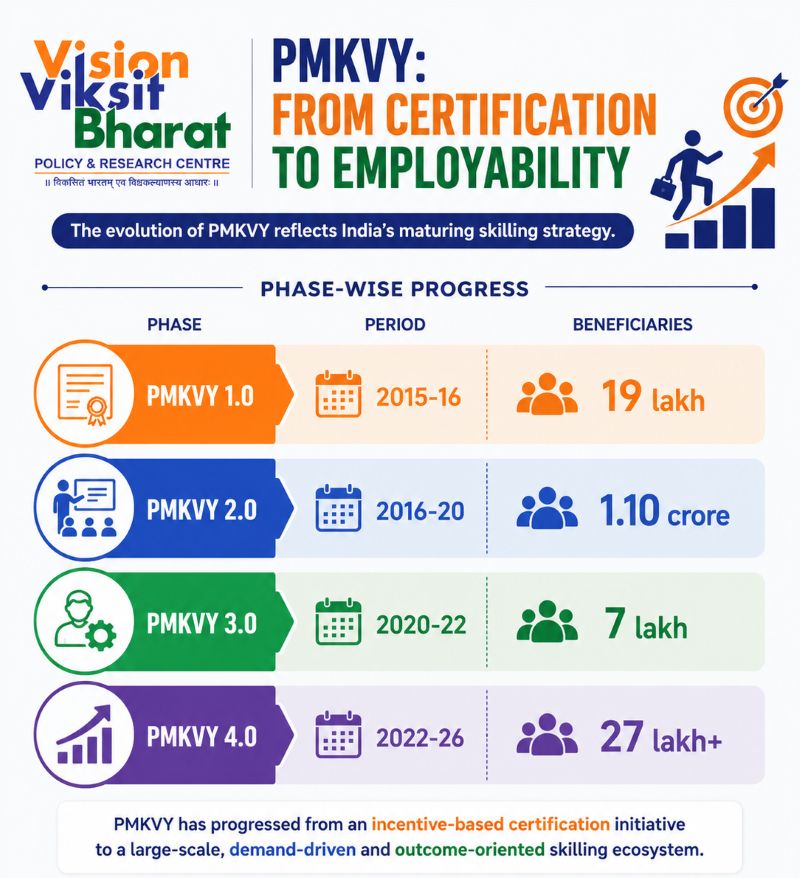
More importantly, PMKVY has evolved from an incentive-based certification scheme into a demand-driven, outcome-oriented framework.
The latest phase incorporates:
- Artificial Intelligence
- Drone Operations
- Green Energy Technologies
- Electronics Manufacturing
- Industry-based On-the-Job Training
- National Skill Qualification Framework (NSQF) alignment
This shift reflects global evidence showing that employability improves significantly when vocational training is linked with practical industry exposure and standardized competency frameworks.
Democratizing Skills: Jan Shikshan Sansthan
One of the most important but often underappreciated reforms has been the revitalization of Jan Shikshan Sansthans (JSS).
Since 2018:
- 36.48 lakh beneficiaries have been trained.
- More than 26,500 tribal beneficiaries have successfully completed training.
- Localized courses have enabled livelihood creation in tailoring, handicrafts, food processing, and health services.
- Integration with the UdyamKart digital marketplace has expanded market access for artisans and micro-entrepreneurs.
This model demonstrates that skilling is not merely about industrial jobs; it is equally about strengthening local economies, preserving traditional crafts, and promoting inclusive growth.
Apprenticeships: Bridging the Education-Employment Gap
International evidence consistently demonstrates that apprenticeship-based systems produce superior employment outcomes.
Countries such as Germany, Switzerland, and Austria maintain some of the lowest youth unemployment rates globally largely because of strong apprenticeship ecosystems.
India’s National Apprenticeship Promotion Scheme (NAPS) seeks to institutionalize similar pathways.
Key Achievements
- 54.41 lakh apprentices engaged since 2016.
- Participation across automotive, manufacturing, retail, electronics, and IT sectors.
- Government stipend support through Direct Benefit Transfer.
- Introduction of Certificate of Proficiency (CoP) in 2025.
The apprenticeship model addresses one of India’s most persistent labour market challenges: graduates possessing qualifications but lacking practical workplace experience.
Reinventing ITIs through PM-SETU
Industrial Training Institutes have historically been the backbone of vocational education in India. However, many suffered from outdated infrastructure and curricula.
The launch of PM-SETU in 2025 marks perhaps the most ambitious ITI modernization initiative in independent India’s history.
Key Features
- ₹60,000 crore investment.
- Upgradation of 1,000 Government ITIs.
- Hub-and-Spoke institutional model.
- Industry co-management through Special Purpose Vehicles.
- National Centres of Excellence in five NSTIs.
- Curriculum redesign aligned with labour market needs.
This reform mirrors successful international models where industry plays an active role in curriculum design, equipment modernization, and trainee assessment.
Preparing for the AI Era: SOAR Initiative
Artificial Intelligence is expected to become a foundational skill similar to digital literacy.
Recognizing this early, India launched SOAR (Skilling for AI Readiness) in 2025.
The initiative introduces AI awareness and foundational AI skills to students from Classes 6–12 through:
- AI to be Aware
- AI to Aspire
- AI to Acquire
Educators receive specialized training in AI ethics, machine learning concepts, and classroom integration.
Partnerships with IBM, Microsoft, and Cisco provide global industry exposure, helping ensure that Indian students are prepared for future jobs rather than merely current occupations.
This aligns with OECD recommendations emphasizing early exposure to computational thinking and AI literacy.
Prime Minister Internship Scheme: Creating Employability at Scale
One of the most significant innovations in India’s workforce strategy is the Prime Minister Internship Scheme (PMIS).
The initiative directly addresses employer concerns regarding graduate readiness.
Highlights
- 63,000+ internship opportunities.
- Financial assistance of ₹9,000 per month.
- One-time grant of ₹6,000.
- Coverage across 730+ districts.
- Joint certification by Government and industry.
The experience of interns such as Avi Rana demonstrates how structured workplace exposure develops professional competencies, confidence, communication skills, and organizational understanding.
Research across labour markets indicates that internship participation significantly improves job placement outcomes and wage prospects.
Skill India Digital Hub: Creating a Digital Public Infrastructure for Skills
India’s digital public infrastructure approach has transformed payments, governance, and service delivery. The same philosophy now extends to skills.
The Skill India Digital Hub (SIDH) represents a unified platform connecting:
- Learners
- Employers
- Apprentices
- Training Providers
- Government Schemes
As of May 2026
- 1.89 crore registered users.
- 1.38 crore e-KYC verifications.
- Access in 23 languages.
- More than 1,000 courses.
- Integration with DigiLocker, UIDAI, e-Shram, PFMS and NCS.
By reducing information asymmetry and transaction costs, SIDH creates a scalable and transparent labour market infrastructure.
SANKALP: Institutionalizing Skill Governance
While training numbers often dominate public discourse, institutional capacity remains equally important.
The World Bank-supported SANKALP programme focused on governance reforms rather than merely training outputs.
Major outcomes include:
- District Skill Committees expanded from 248 to 776.
- District Skill Development Plans increased from 223 to 746 districts.
- 21,602 enterprises established.
- 20,875 Udyam registrations facilitated.
- Over 20,575 wage employment opportunities generated.
- More than 25,000 candidates placed in international job markets.
- AR/VR-based e-Skill labs established.
SANKALP demonstrated that effective skill development requires decentralized planning aligned with local economic realities.
Emerging Challenges
Despite remarkable progress, several challenges remain.
Quality versus Quantity: Training numbers alone cannot guarantee employability. Continuous quality assurance and outcome measurement remain essential.
Rapid Technological Disruption: AI and automation are transforming job roles faster than traditional curriculum revision cycles.
Industry Participation: While improving, employer participation in curriculum design, apprenticeships, and assessment needs further strengthening.
Global Skills Certification: India must align more skill standards with international frameworks to enhance workforce mobility.
Lifelong Learning: Future workers will need continuous reskilling rather than one-time training interventions.
India’s skill development journey over the past decade represents one of the largest workforce transformation initiatives in the world. The transition from isolated training programmes to a comprehensive ecosystem encompassing digital platforms, apprenticeships, AI readiness, internships, entrepreneurship, and industry partnerships reflects a mature and forward-looking policy vision.
The challenge ahead is not merely creating jobs but creating a workforce capable of adapting to technological disruption, participating in global value chains, and driving innovation-led growth. If sustained and continuously refined, India’s skilling architecture can become the cornerstone of Viksit Bharat 2047—transforming the country’s demographic dividend into a decisive economic advantage and positioning India as the world’s leading source of skilled talent in the twenty-first century.
