Innovation as the New Engine of National Growth
Over the last decade, India has witnessed one of the most remarkable entrepreneurial transformations in modern economic history. What began as a policy vision under the Startup India initiative has evolved into a nationwide innovation movement, reshaping employment, investment, technology development, and regional economic growth.
India’s startup ecosystem has expanded from approximately 350-400 startups in 2014-15 to nearly 2.3 lakh recognized startups today. More importantly, these enterprises have generated close to 25 lakh direct jobs, underscoring the role of entrepreneurship as a major pillar of India’s growth strategy.
The startup story is no longer confined to venture capital and technology hubs. It has become a national development story linked directly to the vision of Viksit Bharat 2047.
The Numbers Behind India’s Startup Transformation
The scale of India’s startup expansion is unprecedented.
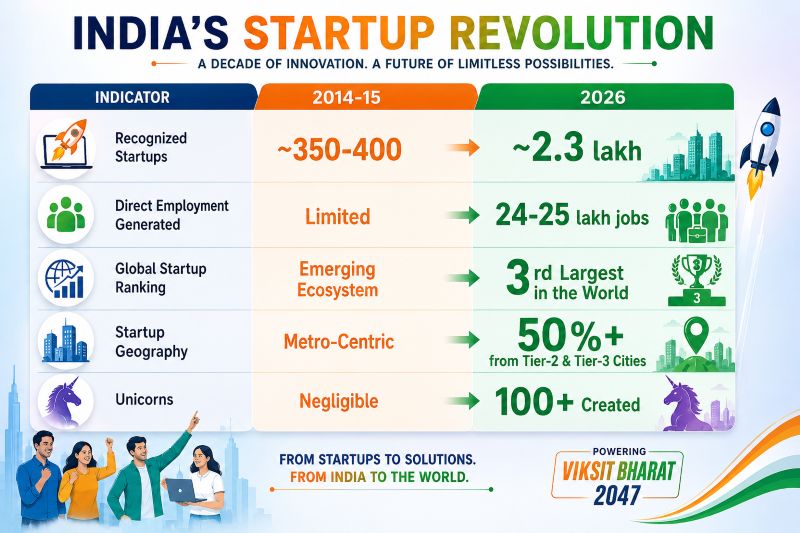
According to DPIIT data, startups are now present across all Indian states and Union Territories, indicating that innovation has become geographically democratized.
This transition reflects a broader structural shift in India’s economy, from a service-led growth model toward an innovation-led growth model.
Startup India: A Policy Experiment That Became a National Movement
When Prime Minister Narendra Modi launched Startup India in January 2016, the objective extended beyond creating new businesses. The initiative sought to transform India’s risk-averse economic culture into one that rewarded innovation and entrepreneurship.
Key reforms included:
- Simplified startup registration
- Tax incentives and exemptions
- Fund of Funds for Startups (FFS)
- Startup India Seed Fund Scheme
- Intellectual Property Rights support
- Faster patent examination
- Regulatory easing and self-certification
- Public procurement access
These measures reduced entry barriers and created an enabling environment for innovators.
The result has been the emergence of entrepreneurship as a viable career option for millions of young Indians.
Employment Generation: The Most Significant Outcome
India faces the challenge of creating millions of quality jobs annually for its young workforce.
Traditional employment generators such as agriculture and government services alone cannot absorb this growing demographic.
Startups have emerged as a powerful alternative.
The nearly 25 lakh jobs generated by startups represent:
- High-skilled employment
- Technology-driven jobs
- Knowledge-intensive careers
- New-age manufacturing opportunities
- Gig and platform-based livelihoods
Research by NASSCOM and industry bodies consistently shows that startup ecosystems create multiplier effects across supply chains, logistics, professional services, and local economies.
For every direct startup job, several indirect employment opportunities are generated in ancillary sectors.
The Rise of Bharat’s Entrepreneurial Cities
Perhaps the most transformative development is the emergence of Tier-2 and Tier-3 cities as startup hubs.
More than 50 percent of startups now originate outside metropolitan regions.
Cities such as:
- Indore
- Jaipur
- Bhubaneswar
- Coimbatore
- Lucknow
- Surat
- Kochi
- Nagpur
- Dehradun
- Mysuru
are increasingly becoming centres of innovation.
This shift is significant because it aligns with the objective of balanced regional development.
Digital infrastructure, affordable internet, UPI-led financial inclusion, and widespread smartphone penetration have enabled entrepreneurs to build globally scalable businesses from smaller towns.
The startup revolution is therefore reducing geographic inequalities in economic opportunity.
Deep-Tech: The Next Frontier: The RISE Conclave 2026 brought together more than 125 startups, many working in advanced technology domains.
India’s next startup wave is likely to emerge from deep-tech sectors such as:
Aerospace: The success of mach33.aero, India’s first public-private aerospace incubation centre established by CSIR-NAL, demonstrates growing capabilities in aviation technologies, drones, propulsion systems, and advanced materials.
Artificial Intelligence: The IndiaAI Mission is building computing infrastructure, datasets, talent pipelines, and innovation ecosystems that could position India among leading AI economies.
Quantum Technologies: The National Quantum Mission, launched with a long-term roadmap, is advancing capabilities in:
- Quantum communication
- Quantum sensing
- Quantum computing
- Quantum cryptography
Biotechnology: India’s biotechnology industry has grown from a few billion dollars to over $150 billion in value, creating opportunities in healthcare, agriculture, diagnostics, and bio-manufacturing.
Space Economy: Following the opening of the space sector to private participation, Indian startups are entering satellite manufacturing, launch systems, geospatial services, and space applications.
Innovation and National Competitiveness
India’s startup growth is closely linked with improvements in innovation indicators.
Over the last decade:
- India’s ranking in the Global Innovation Index has improved substantially.
- Domestic patent filings have reached record levels.
- Research output and citation impact have increased.
- Industry-academia collaboration has strengthened.
These trends indicate a shift from technology consumption toward technology creation.
Historically, nations that achieved high-income status invested heavily in innovation ecosystems.
Examples include:
- United States (Silicon Valley)
- Israel (Startup Nation)
- South Korea (Technology-led Growth)
- Singapore (Innovation Economy)
India’s startup ecosystem is now moving in a similar direction.
Challenges That Require Policy Attention
Despite remarkable progress, several challenges remain.
Access to Growth Capital: While seed funding has improved, startups often struggle to secure late-stage capital. Policy support is needed to deepen domestic venture capital and pension fund participation.
Research Commercialization: India produces substantial scientific research, but commercialization rates remain relatively low. Stronger industry-academia partnerships are required.
Deep-Tech Financing: Deep-tech startups typically require longer gestation periods and higher capital investments. Dedicated funding mechanisms can accelerate innovation in strategic sectors.
Talent Development: Future industries will require expertise in:
- AI
- Robotics
- Semiconductors
- Quantum technologies
- Cybersecurity
- Advanced manufacturing
Higher education institutions must align curricula with emerging technology needs.
Global Market Access
Indian startups must increasingly become global innovators rather than domestic market players alone. Export-oriented startup policies can support this transition.
The success of the RISE Conclave 2026 demonstrates that India’s innovation ecosystem is maturing rapidly. However, future success must be measured not merely by the number of startups created but by outcomes such as technologies commercialized, patents monetized, industries transformed, jobs generated, and global market leadership achieved.
As India moves toward the centenary of Independence in 2047, the country’s laboratories, incubators, universities, industries, and entrepreneurs will play a decisive role in shaping its developmental trajectory. The journey from 350 startups to 2.3 lakh enterprises is not merely a statistical achievement. It represents the emergence of a new India, confident, innovative, technology-driven, and prepared to lead in the knowledge economy of the 21st century.
The startup revolution is no longer an economic phenomenon; it is a national movement powering the realization of Viksit Bharat 2047.
