Building a New Global Hub Where Economic Prosperity, Civilizational Values, Technology and Sustainability Converge
In an era when nations are competing to attract global investments, develop advanced infrastructure, strengthen technological capabilities and build resilient economies, Bhutan has embarked on an exceptionally ambitious experiment in nation-building. The Gelephu Mindfulness City (GMC), envisioned by His Majesty King Jigme Khesar Namgyel Wangchuck, represents an effort to redefine the relationship between economic development, human well-being, environmental sustainability and civilizational identity.
Announced on 17 December 2023, the project seeks to transform Gelephu in southern Bhutan into an international economic, technological, educational, financial and spiritual hub. Spread across a planned development area of approximately 2,500 square kilometres in its original masterplan, the city is envisioned as a Special Administrative Region with a distinctive governance and regulatory framework.
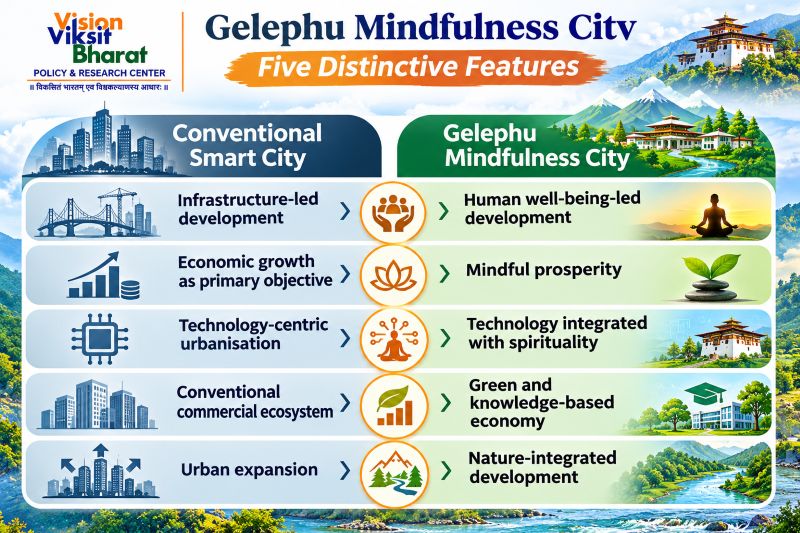
What makes this initiative particularly significant is its underlying philosophy. Rather than following the conventional model of urbanisation driven primarily by industrial expansion, real estate development and commercial activity, Bhutan seeks to establish an ecosystem in which economic prosperity coexists with mindfulness, ecological balance, cultural heritage and social well-being.
The initiative also carries considerable significance for India. Gelephu’s geographical proximity to Assam and its strategic location in the eastern Himalayan region create opportunities to strengthen India-Bhutan economic cooperation, improve connectivity with the Northeast, attract investments, expand trade and develop new regional economic corridors.
Gelephu Mindfulness City could therefore emerge not merely as Bhutan’s transformation project, but as a significant regional development initiative with implications for India’s Act East Policy, Northeast development and the broader vision of Viksit Bharat 2047.
1. The Vision Behind Gelephu Mindfulness City
From Gross National Happiness to a New Global Economic Ecosystem
Bhutan has long distinguished itself through its development philosophy of Gross National Happiness (GNH), which places human well-being, environmental conservation, cultural preservation and good governance alongside economic progress.
Gelephu Mindfulness City seeks to translate this philosophy into a modern economic and urban development framework. The objective is to establish a destination where international businesses, investors, entrepreneurs, researchers, students, professionals and tourists can participate in a new economic ecosystem without compromising the values that define Bhutan.
The proposed city is designed around several interconnected economic sectors.
- International finance, fintech and digital assets.
- Information technology, artificial intelligence and emerging technologies.
- Education, research and innovation.
- Healthcare, wellness and holistic medicine.
- Sustainable agriculture, biotechnology and food processing.
- Renewable energy and green industries.
- Aviation, logistics and international trade.
- Sustainable tourism and cultural experiences.
The project also envisages modern infrastructure, international connectivity, advanced digital networks, educational institutions, healthcare facilities, green urban districts and nature-integrated development.
Its architectural and urban planning approach draws inspiration from Bhutanese traditions, natural landscapes and the principles of Gross National Happiness. International planning and design organisations, including Bjarke Ingels Group (BIG), have contributed to the masterplanning vision.
The larger ambition is to establish a globally connected economy that remains rooted in local culture, environmental responsibility and human values.
2. India’s Support for Gelephu Mindfulness City
A Strategic Partnership Rooted in Trust, Connectivity and Shared Development
India has emerged as an important development partner in the realisation of Gelephu Mindfulness City. The Indian approach reflects the longstanding relationship between the two countries, built on mutual trust, economic cooperation, cultural affinity and strategic partnership.
India’s support is not limited to diplomatic endorsement. It is increasingly reflected in concrete initiatives involving transport connectivity, border infrastructure, energy cooperation, financial assistance, technology and people-to-people exchanges.
During Prime Minister Narendra Modi’s state visit to Bhutan on 11-12 November 2025, India formally reaffirmed its full support for the realisation of the Gelephu Mindfulness City vision. The announcement of an Immigration Check Post at Hatisar in Assam was particularly significant, as it is intended to facilitate the movement of investors and visitors travelling to Gelephu.
India’s support can be understood through the following major dimensions.
A. Railway Connectivity Between India and Bhutan
One of the most transformative components of India-Bhutan cooperation is the proposed cross-border railway connectivity.
On 29 September 2025, India and Bhutan signed an Inter-Governmental Memorandum of Understanding for two railway links.
- Kokrajhar in Assam to Gelephu in Bhutan.
- Banarhat in West Bengal to Samtse in Bhutan.
The two railway links together cover approximately 88 kilometres, with an estimated investment of ₹4,033 crore.
The Kokrajhar-Gelephu railway connection is especially important because it will provide a direct rail interface between India’s Northeast and Bhutan’s proposed international economic hub.
It can facilitate the movement of passengers, construction materials, industrial inputs, agricultural products and commercial cargo. It will also create opportunities for logistics companies, local businesses, tourism operators and industries in the surrounding districts.
For India, this infrastructure can strengthen the economic integration of Assam and neighbouring states with Bhutan while creating additional trade and transport routes towards wider regional markets.
B. Road Connectivity and Integrated Border Infrastructure
Road infrastructure and efficient border management will be essential for the success of GMC. India and Bhutan are working towards improving cross-border movement through immigration facilities, land customs stations, logistics infrastructure and better transport connectivity.
Some important developments include:
- Operationalisation of the Darranga Immigration Check Post in Assam in November 2024.
- Announcement of a new Immigration Check Post at Hatisar, Assam, in November 2025.
- Operationalisation of the Inland Waterways Terminal and Multimodal Logistics Park at Jogighopa in March 2025.
- Operationalisation of Samrang Land Customs Station in August 2026.
- Ongoing cooperation on improved border infrastructure and integrated check posts.
These developments have significance beyond Bhutan. They can strengthen Assam’s position as a logistics and commercial gateway for the eastern Himalayan region. Jogighopa, in particular, can complement the development of Gelephu by providing multimodal logistics facilities and improving access to inland waterways and regional transport networks.
C. Financial and Developmental Assistance
India’s development partnership with Bhutan is among the most substantial bilateral development partnerships in the region. For Bhutan’s 13th Five Year Plan, covering July 2024 to June 2029, the Government of India has committed ₹10,000 crore in development assistance.
This is a broader commitment covering Bhutan’s national development priorities and should not be interpreted as funding exclusively allocated to Gelephu Mindfulness City.
Additionally, during Prime Minister Modi’s November 2025 visit, India announced a concessional Line of Credit of ₹4,000 crore for energy projects in Bhutan. This strengthens the energy foundation required for Bhutan’s long-term economic expansion.
The wider development partnership includes:
- Infrastructure and road development.
- Digital connectivity and ICT.
- Education and human resource development.
- Healthcare and public services.
- Agriculture and rural development.
- Hydropower and renewable energy.
- Community development initiatives.
These investments contribute to the broader economic ecosystem within which Gelephu is being developed.
D. Energy Cooperation and Green Development
Energy cooperation is a central pillar of India-Bhutan relations. Bhutan possesses considerable hydropower potential, while India has a growing demand for clean and reliable electricity. Their partnership therefore creates mutual economic and environmental benefits.
On 11 November 2025, Prime Minister Narendra Modi and the King of Bhutan jointly inaugurated the 1,020 MW Punatsangchhu-II Hydroelectric Project. Electricity exports from the project to India also commenced.
The two countries have also strengthened their cooperation in renewable energy, solar power and green hydrogen.
For Gelephu, reliable clean energy will be essential to support data infrastructure, industrial activities, commercial establishments, healthcare facilities and modern urban services.
For India, the partnership contributes to clean electricity availability, regional energy security and progress towards its energy transition objectives.
E. Digital Economy, Fintech and Technology Cooperation
India and Bhutan have already established a foundation for digital economic cooperation through RuPay, UPI and other technology partnerships. The expansion of digital payment interoperability, collaboration in artificial intelligence and knowledge exchange can create opportunities for a more integrated regional digital economy.
During the India-Bhutan leadership meeting in February 2026, both Prime Ministers agreed to strengthen cooperation in artificial intelligence and digital technologies through experience-sharing and joint development of AI solutions.
Potential areas of cooperation linked to GMC include:
- Digital financial services and fintech.
- Artificial intelligence and data-driven governance.
- Cybersecurity and digital public infrastructure.
- Blockchain and emerging financial technologies.
- Digital education and research.
- Smart mobility and urban management.
India’s experience in developing population-scale Digital Public Infrastructure, including UPI, Aadhaar and digital service delivery, can provide valuable knowledge and technological partnerships for Bhutan’s emerging digital ecosystem.
F. Cultural and Civilizational Cooperation
The India-Bhutan partnership extends beyond economics and infrastructure. It is deeply rooted in shared Buddhist heritage and civilizational connections. An important symbol of this relationship emerged on 1 November 2026, when India’s Union Minister Kiren Rijiju represented the Government of India at the raising and consecration of 108 stupas in Gelephu Mindfulness City.
The 108 stupas, each approximately 15 metres tall, were erected along an 11.7-kilometre stretch of the Aie (Mau) River. One of these stupas was dedicated by the King of Bhutan to Prime Minister Narendra Modi in recognition of his support for the Gelephu vision.
This gesture reflects the depth of the cultural and spiritual relationship between the two countries.
India’s Buddhist heritage, including Bodh Gaya, Sarnath, Rajgir, Nalanda and other sacred destinations, can complement Bhutan’s ambition to establish Gelephu as an international centre for Buddhist spirituality, mindfulness and cultural tourism.
Such cooperation can also strengthen India’s Buddhist tourism ecosystem and promote the shared heritage of the Himalayan region.
3. How Gelephu Mindfulness City Will Benefit India
Transforming the Northeast into a Regional Economic Gateway
The strategic importance of Gelephu Mindfulness City for India extends far beyond its geographical proximity to Assam. It offers an opportunity to connect the economic potential of India’s Northeast with a new international investment, tourism, technology and commercial destination.
For decades, the Northeast has faced challenges related to geographical connectivity, logistics costs, access to markets and industrial investment. GMC could help create additional economic opportunities by connecting Bhutan’s emerging economic hub with Indian transport, energy and commercial networks.
The benefits for India can be understood across several dimensions.
A. Economic Growth and Investment Opportunities
As Gelephu develops into an international commercial and financial destination, Indian companies can explore opportunities in infrastructure, construction, hospitality, healthcare, education, banking, IT, renewable energy and professional services.
Indian enterprises could participate in the development of the city’s economic ecosystem through investment, technology partnerships, consultancy, construction and service delivery.
Potential opportunities include:
- Indian construction and engineering companies participating in infrastructure development.
- Indian IT companies providing digital platforms and technology solutions.
- Indian financial institutions exploring fintech and financial services partnerships.
- Indian universities establishing academic and research collaborations.
- Indian healthcare providers developing specialised medical and wellness services.
- Indian startups exploring regional business opportunities.
This can create new avenues for Indian enterprises to expand their regional and international presence.
B. Economic Transformation of Assam and the Northeast
This can generate opportunities in:
- Warehousing and logistics.
- Food processing and agricultural exports.
- Tourism and hospitality.
- Construction and infrastructure services.
- Trade and cross-border commerce.
- Education and skill development.
- Small businesses and entrepreneurship.
The benefits may extend to Meghalaya, Arunachal Pradesh, Nagaland, Manipur and other Northeastern states through improved regional connectivity and tourism linkages.
The larger opportunity is to position the Northeast not merely as a geographically remote region, but as an emerging gateway connecting India with Bhutan and wider regional markets.
C. Strengthening India’s Act East Policy
Gelephu can contribute to India’s Act East Policy by strengthening land-based connectivity and economic cooperation in the eastern Himalayan region.
The United Nations Economic and Social Commission for Asia and the Pacific has identified the potential of Gelephu as a gateway to Southeast Asia, emphasising the importance of improved infrastructure, logistics, trade facilitation and regional integration.
With suitable connectivity and trade arrangements, the city could complement India’s existing regional connectivity initiatives and create additional opportunities for economic engagement with neighbouring countries.
It is important to recognise that Gelephu alone will not create a direct corridor to Southeast Asia. Its contribution will depend on coordinated transport infrastructure, cross-border procedures and wider regional agreements.
D. Strengthening Regional Energy Security
India’s partnership with Bhutan in hydropower has already demonstrated the potential of mutually beneficial regional energy cooperation.
Gelephu’s development can strengthen this relationship by encouraging further cooperation in:
- Hydropower generation and transmission.
- Solar and renewable energy.
- Green hydrogen.
- Energy storage technologies.
- Clean energy research.
- Cross-border electricity markets.
For India, this can contribute to the diversification of clean energy sources and strengthen energy cooperation with a trusted neighbouring country.
E. Tourism and the Buddhist Civilizational Circuit
Gelephu’s ambition to become an international destination for spirituality and mindfulness creates a unique opportunity for India.
India possesses some of the world’s most important Buddhist heritage sites, while Bhutan has preserved a distinctive living Buddhist tradition.
Together, the two countries can promote an integrated Buddhist tourism circuit connecting:
- Bodh Gaya.
- Rajgir and Nalanda.
- Sarnath.
- Kushinagar.
- Sikkim and Arunachal Pradesh.
- Thimphu, Paro and Gelephu.
This can attract international visitors interested in Buddhism, meditation, philosophy, heritage and spiritual experiences.
It can also strengthen India’s position as a global destination for Buddhist pilgrimage and cultural tourism.
F. Employment, Skills and Entrepreneurship
The growth of GMC can generate employment opportunities for Indian professionals, engineers, architects, technology specialists, hospitality professionals, researchers and entrepreneurs.
Northeastern youth could particularly benefit from emerging opportunities in tourism, logistics, construction, trade, digital services and professional education.
Indian educational institutions and skill development organisations can explore partnerships with Bhutanese institutions to develop a skilled workforce for the emerging economic ecosystem.
The project can therefore contribute to employment generation not only within Bhutan but also across neighbouring Indian states.
G. Strategic Stability and Neighbourhood Cooperation
A prosperous, stable and economically connected Bhutan is in India’s long-term strategic interest.
GMC can strengthen the economic interdependence between the two countries through infrastructure, energy, trade, investment and people-to-people connectivity.
India’s support for Bhutan’s development also reinforces a model of neighbourhood cooperation based on mutual respect, sovereign equality, trust and shared prosperity.
This is particularly relevant in a region where economic connectivity and strategic partnerships are increasingly important to regional stability.
4. Gelephu as a Model for the World
Perhaps the most significant contribution of Gelephu Mindfulness City could be its ability to demonstrate an alternative approach to modern development.
For decades, global urbanisation has largely followed a model in which cities compete through industrial capacity, commercial real estate, financial markets, technological infrastructure and population growth. Although this model has generated economic prosperity, it has also created challenges such as environmental degradation, urban congestion, social inequality, stress and declining quality of life.
Bhutan is attempting to explore a different development paradigm. Gelephu’s central proposition is that economic competitiveness and human well-being should not be treated as competing priorities. Instead, they should reinforce each other.
If successfully implemented, the project could offer valuable lessons to governments, urban planners, investors, policymakers and development institutions across the world.
A. Redefining the Meaning of Development
The project challenges the assumption that the success of a city should be measured primarily through GDP, investment inflows, industrial output and real estate growth.
It seeks to incorporate additional indicators such as:
- Human happiness and mental well-being.
- Environmental quality and biodiversity.
- Cultural preservation and community participation.
- Access to healthcare and education.
- Sustainable employment and economic opportunity.
- Social trust and quality of life.
This approach could contribute to the evolution of a more comprehensive framework for measuring development.
B. Integrating Technology with Human Values
However, technological advancement also raises questions concerning privacy, inequality, mental health, social isolation and the ethical use of technology.
Gelephu offers an opportunity to explore how technological advancement can be guided by human values.
Its proposed digital and financial ecosystem, combined with mindfulness and environmental principles, could provide useful lessons in responsible innovation.
The idea is not simply to build a smart city, but to develop a city in which technology improves the quality of human life.
C. Demonstrating That Economic Growth and Ecological Conservation Can Coexist
Bhutan is internationally recognised for its environmental conservation policies and carbon-negative status.
Gelephu’s planning approach seeks to retain these environmental commitments while creating a modern economic hub.
Its infrastructure planning includes nature-based solutions, sustainable mobility, renewable energy, water management, biodiversity protection and climate resilience.
The proposed development framework places particular importance on protecting natural landscapes and integrating rivers, forests and green corridors into urban design.
If these principles are maintained during construction and operation, GMC could demonstrate how economic expansion can be pursued without treating nature as an expendable resource.
D. Creating a New Model of International Investment
The project also offers an interesting experiment in governance and investment facilitation.
Its Special Administrative Region framework seeks to provide institutional autonomy, a distinctive regulatory environment and greater international business engagement within Bhutan’s national framework.
This could provide lessons for countries seeking to attract global capital, entrepreneurs and specialised talent while retaining national sovereignty and institutional accountability.
Its success will depend on regulatory clarity, transparency, legal certainty, investor confidence and effective public institutions.
E. Reviving Civilizational Identity in Modern Development
One of the most distinctive dimensions of Gelephu is its emphasis on civilizational identity.
Many modern cities have developed around commercial and industrial priorities, often weakening their relationship with local history, architecture, culture and traditional knowledge.
Gelephu seeks to place Bhutanese cultural traditions, Buddhist philosophy, spiritual practices and community values at the centre of its development vision.
This creates an important proposition for the world. Modernisation does not necessarily require societies to abandon their cultural identity. A country can embrace artificial intelligence, international finance, advanced infrastructure and global trade while retaining its historical values and philosophical foundations.
For developing countries with rich cultural and civilizational traditions, this could be an especially valuable lesson.
5. What Can Other Countries Learn from Gelephu?
A New Framework for 21st-Century Development
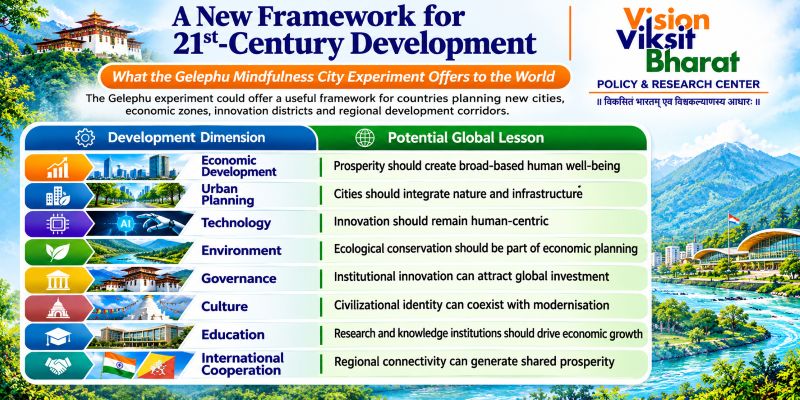
The project could be studied by countries in Asia, Africa, the Middle East and Latin America that are exploring new economic development models.
However, Gelephu should not be viewed as a ready-made blueprint that every country can replicate. Its governance model, cultural foundation, geography and environmental context are distinctly Bhutanese. Its wider relevance will come from the principles it demonstrates and the evidence generated through implementation.
7. Strategic Opportunities for India and Vision Viksit Bharat 2047
Connecting India’s Development Aspirations with a New Himalayan Economic Ecosystem
The project is particuFirst, Viksit Bharat 2047. India’s ambition to become a developed nation requires strong regional economic ecosystems, advanced infrastructure, technological innovation, sustainable cities and international partnerships. GMC can become a case study in integrating these priorities.
Second, Act East Policy. Better connectivity between Assam, Bhutan and wider regional markets can strengthen India’s engagement with its eastern neighbourhood and create additional economic opportunities for the Northeast.
Third, Viksit Northeast. The development of transport, logistics, tourism, energy and trade infrastructure can help unlock the economic potential of India’s Northeastern states.
For Vision Viksit Bharat Policy & Research Centre, Gelephu also presents an opportunity to undertake comparative research on civilizational development models, sustainable urbanisation, regional economic integration and India’s neighbourhood development partnerships.
Gelephu Mindfulness City and the Future of Civilizational Development
Gelephu Mindfulness City represents an ambitious attempt to redefine how nations approach economic growth, urbanisation, technology and human well-being.
Under the visionary leadership of His Majesty King Jigme Khesar Namgyel Wangchuck, Bhutan is seeking to build a globally connected economic hub without abandoning its cultural identity, environmental commitments and philosophical foundations.
India’s support adds an important regional dimension to this initiative. Railway connectivity, border infrastructure, energy cooperation, financial assistance, digital partnerships and cultural exchanges can help transform the project into a shared opportunity for Bhutan and India’s Northeast.
For India, the success of Gelephu could create new economic opportunities, strengthen the Act East Policy, improve regional connectivity, expand trade and deepen its strategic partnership with Bhutan.
For the international community, the project presents an opportunity to examine a development model in which economic competitiveness is pursued alongside ecological responsibility, technological advancement, cultural continuity and human happiness.
Its ultimate success will depend on how effectively the vision is translated into institutions, infrastructure, investment, employment and measurable improvements in people’s lives.
The larger message is significant. The future of development need not be defined exclusively by the speed of industrialisation, the scale of urban expansion or the volume of economic output. It can also be defined by the quality of life, harmony with nature, preservation of civilizational values and the well-being of future generations.
Gelephu could become an important global experiment in demonstrating this proposition.
For India and Bhutan, it offers an opportunity to build not merely a new economic destination, but a shared vision of regional prosperity rooted in trust, sustainability and civilizational friendship.
The world may eventually recognise Gelephu not simply as a new city in the Himalayas, but as an important experiment in reimagining the purpose of development in the 21st century.
