The next employment revolution will not simply change who gets hired. It will change why organisations hire, what they pay for, and how careers are built.
For decades, the corporate world has operated on a relatively predictable employment model. Organisations recruit large numbers of fresh graduates, assign them repetitive operational responsibilities, develop a smaller proportion into supervisors and managers, and gradually promote a select few into senior leadership. This structure resembles a pyramid, with a broad base of entry-level employees, a narrowing middle of managers, and a small leadership apex.
Business management education evolved around this structure. MBA and PGDM institutions taught students the fundamentals of marketing, finance, human resources, operations, and strategy, with the expectation that graduates would enter organisations at the lower or middle levels, learn through experience, and gradually move upwards.
Artificial intelligence is challenging the economic logic behind this model. When AI systems can generate reports, analyse financial statements, prepare presentations, process transactions, interpret customer data, support recruitment, automate documentation, and coordinate routine workflows, organisations may need fewer people to perform the repetitive tasks that traditionally justified large entry-level teams. The change will not be uniform, immediate, or identical across industries. Nevertheless, it raises a fundamental question for management education.
If businesses can automate a substantial proportion of the work traditionally assigned to fresh graduates, what exactly should an MBA or PGDM graduate be trained to do? The answer cannot be limited to learning AI tools. It requires a fundamental rethinking of the relationship between education, organisational design, employability, and economic value creation.
The next generation of management graduates must be prepared not merely to enter the corporate hierarchy, but to create value in organisations where routine execution is increasingly automated, human responsibility is concentrated in higher-value work, and the ability to manage intelligent systems becomes a defining professional capability.
1. The emergence of the AI diamond
The most useful way to understand the coming organisational transformation is through three possible structures. The traditional pyramid has a broad operational base, a substantial supervisory layer, and a narrow leadership apex. The emerging AI-enabled organisation may have a smaller operational base, a wider middle comprising analytical, specialised, and decision-oriented professionals, and a lean leadership team.
This can be described as the AI diamond hypothesis. The diamond is not a prediction that every company will adopt an identical organisational chart. It is a strategic model for understanding what happens when the cost of routine execution falls while the demand for judgement, coordination, domain expertise, and accountability remains.
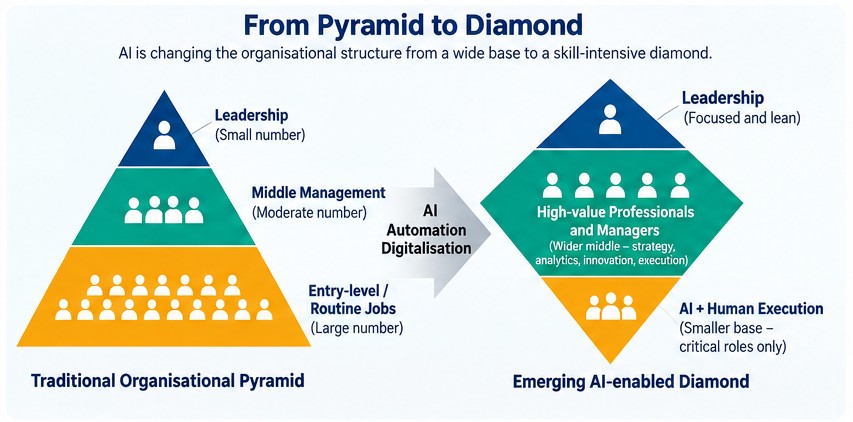
Under the traditional model, companies often employed large teams to collect information, prepare reports, reconcile records, monitor performance, and execute standardised processes. Managers supervised these activities and escalated important decisions upwards.
Under an AI-enabled model, a smaller team may be able to accomplish much of this work through automated workflows. The organisation’s competitive advantage then depends increasingly on the people who can identify the right problems, interpret machine-generated insights, coordinate multiple functions, make trade-offs, manage exceptions, and convert analysis into business outcomes.
The implication is significant. The middle of the organisation may become more valuable, even as the total number of employees required for certain activities declines.
However, there is an important counterforce. If AI also automates analytical work, coding, research, reporting, and parts of coordination, some middle-management positions may shrink as well. Consequently, the most plausible future is not necessarily a perfect diamond. It is a more selective, skill-intensive organisation in which employment growth concentrates around roles that combine technological capability with business judgement and accountability.
The question for management institutions is therefore not whether the pyramid will disappear entirely. It is whether they are preparing students for a corporate structure that may no longer exist in its traditional form.
2. What research tells us about the future of employment
The emerging evidence supports a transformation of jobs rather than a simple narrative of universal replacement.
The World Economic Forum’s Future of Jobs Report 2025 estimates that, by 2030, structural labour-market changes could create 170 million jobs and displace 92 million, producing a projected net increase of 78 million jobs globally. It also estimates that approximately 39% of workers’ existing skills may be transformed or become outdated over the period. These are employer-based global projections, not guaranteed outcomes for individual countries, institutions, or professions. Source. (World Economic Forum, Future of Jobs Report 2025.)
The International Labour Organization’s 2025 research on generative AI provides a complementary perspective. It estimates that roughly one in four workers globally is in an occupation with some degree of exposure to generative AI. Yet the ILO concludes that transformation is more likely than complete replacement for most occupations because human input remains necessary across many tasks. Source. (International Labour Organization, Generative AI and Jobs, 2025 update.)
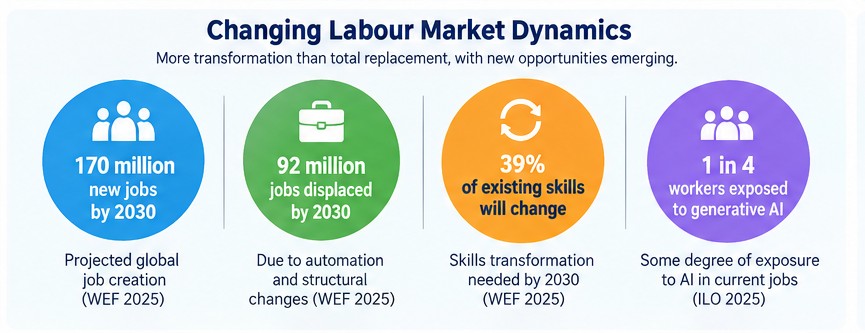
These findings must be interpreted carefully. Exposure does not automatically mean job loss. Actual outcomes depend on the cost and reliability of technology, organisational readiness, regulation, customer expectations, infrastructure, and the creation of new demand.
Nevertheless, the research points to a critical distinction. The unit of technological disruption is often the task, whereas the unit of employment is the job. A financial analyst does not necessarily disappear when AI automates the preparation of financial models. A marketing executive does not necessarily disappear when AI generates campaign drafts. A procurement professional does not necessarily disappear when software compares supplier quotations.
Instead, the composition of their work changes. Less time may be spent on routine production, and more value may be expected from interpretation, validation, negotiation, exception management, and decisions. The challenge is that employers may not need to retain the same number of people to perform the redesigned jobs.
For management graduates, this creates both an opportunity and a risk. Those who learn to work above the level of routine execution may become more productive and valuable. Those whose principal advantage is the ability to perform standardised tasks may find their bargaining power weakening.
3. The entry-level employment paradox
One of the most consequential changes may be the shrinking of the traditional entry point into professional careers. Historically, fresh graduates entered corporate organisations through roles involving data preparation, documentation, reporting, research assistance, customer support, transaction processing, sales coordination, and operational execution. These roles were not merely jobs. They were the training ground through which graduates learned how businesses functioned.
A junior finance professional learnt financial discipline while preparing reports. A marketing executive understood customers while coordinating campaigns. A procurement analyst learnt commercial judgement while comparing quotations. A human resources executive developed interpersonal skills while managing recruitment and employee records.
AI can now perform or accelerate many of the underlying tasks. Consequently, an employer may increasingly ask why it should recruit several inexperienced graduates to perform work that a smaller team using AI-enabled systems can complete.
This creates an entry-level employment paradox. Graduates are expected to possess experience to secure their first professional role, but the traditional junior roles through which they acquired that experience may become fewer or more demanding.
The issue is not necessarily that companies will stop hiring fresh graduates. It is that they may change the criteria for hiring them. Academic qualifications and theoretical knowledge may be insufficient when employers expect new recruits to demonstrate practical competence from the beginning.
For MBA and PGDM institutions, this means that employability cannot be postponed until the final placement semester. Students must graduate with evidence that they can solve real business problems, work with imperfect data, use AI responsibly, communicate with stakeholders, and deliver measurable outcomes.
The degree must become evidence of demonstrated capability, not merely evidence of course completion.
4. The middle of the organisation may become the new battleground
If routine execution becomes cheaper, the greatest professional opportunity may lie in roles that connect technology with business performance.
Consider the modern supply chain. An AI system may forecast demand, identify inventory anomalies, compare supplier prices, and recommend replenishment quantities. Yet a business still needs professionals who understand supplier reliability, production constraints, contractual obligations, geopolitical risks, working capital, and customer commitments.
Similarly, AI can analyse campaign performance and recommend customer segments, but a business needs people who understand brand positioning, consumer psychology, channel economics, competitive behaviour, and commercial priorities. The same principle applies to finance, human resources, consulting, operations, and general management.
This points towards a new category of professional, the AI-enabled business integrator. Such a professional does not need to build every algorithm or become a full-time software engineer. Instead, the professional understands the business problem, selects appropriate tools, interprets their output, challenges unreliable conclusions, coordinates people and systems, and takes responsibility for the result.
Potential areas of opportunity include the following.
- Business process transformation and automation management.
- AI-enabled financial planning, forecasting, and commercial analysis.
- Supply chain analytics, procurement intelligence, and risk management.
- Revenue operations, customer intelligence, and sales effectiveness.
- Human resources analytics, workforce planning, and skills transformation.
- Product operations, business analysis, and digital implementation.
- AI governance, risk controls, compliance, and responsible adoption.
- Project and programme management for technology-enabled change.
These roles will not all grow automatically, and their titles will vary between employers. The underlying capabilities, however, are relevant across many sectors.
The new advantage will belong to professionals who can bridge the gap between what technology can produce and what a business should actually do.
5. The disappearance of routine work does not mean the disappearance of human value
A major mistake in discussions about AI is to assume that human value is determined by how much information a person can process or how quickly a task can be completed. For many years, professional competence was demonstrated through the ability to prepare an accurate report, create a financial model, produce a presentation, analyse a dataset, or execute a defined process.
These capabilities remain useful. But when technology can perform them rapidly, their standalone market value may decline. Human value increasingly lies in determining which report matters, whether the assumptions behind a model are credible, what information is missing, which business risk deserves attention, how competing priorities should be balanced, and who should be accountable for the decision.
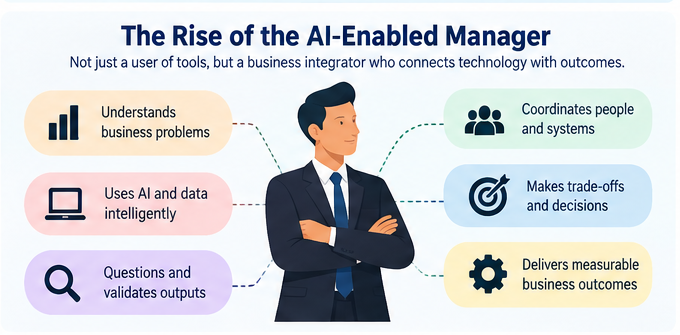
This is where judgement becomes economically important. AI may recommend the cheapest supplier, but a manager must consider delivery reliability, quality failures, geopolitical exposure, and the long-term commercial relationship. AI may recommend reducing a workforce, but a leader must consider organisational capability, morale, legal obligations, and the consequences for future growth.
AI may generate a business strategy, but a management team must decide whether the strategy is feasible, ethical, financially sustainable, and aligned with the organisation’s objectives. The future manager must therefore be capable of questioning the machine, not merely operating it.
Critical thinking, communication, negotiation, ethical reasoning, creativity, leadership, and the ability to work with uncertainty will become more important when routine cognitive work is increasingly accessible through technology. This is not an argument for abandoning technical skills. It is an argument for combining technical fluency with human judgement.
The most employable graduate will not necessarily be the person who knows the largest number of AI applications. It may be the person who knows when to use them, when to distrust them, and how to translate their output into responsible business action.
6. The labour market will change in at least six additional ways
The transformation will extend beyond the number of jobs and the shape of organisational charts. First, skill-based recruitment may become more important than qualification-based screening. Employers will increasingly have opportunities to assess candidates through work samples, simulations, portfolios, and practical demonstrations. Degrees will continue to matter, but the ability to demonstrate competence may carry greater weight in many roles.
Second, careers may become less linear. A professional may move between operations, analytics, product management, consulting, and entrepreneurship rather than following a predictable progression through a single department. Career resilience will depend on transferable skills and continuous learning.
Third, smaller teams may manage larger business portfolios. AI-enabled professionals may supervise multiple workflows, customers, markets, or projects. This could raise productivity and create opportunities for high performers, while increasing the pressure on employees to manage complexity.
Fourth, the wage premium may shift towards people who combine domain expertise with AI capability. Merely knowing how to use an AI assistant may become commonplace. The differentiator will be the ability to apply it within a specific commercial context and generate measurable value.
Fifth, employment may become more unevenly distributed. Some workers may benefit from higher productivity and more valuable responsibilities, while others may experience displacement, slower wage growth, or greater insecurity. The benefits of automation will depend partly on how organisations distribute productivity gains and invest in reskilling.
Sixth, new work will emerge around the implementation and control of AI itself. Organisations will require capabilities in data quality, systems integration, model evaluation, cybersecurity, privacy, governance, human oversight, and process redesign. Some of these roles will be technical, while others will require management graduates who understand both business processes and technology-related risks.
For India, the outcome will also depend on the country’s ability to create new enterprises, expand formal employment, improve digital capabilities, and translate productivity gains into additional demand. A young workforce is an advantage only when its skills align with economic opportunities.
The objective should not be to preserve every existing task. It should be to build an economy capable of creating meaningful, productive work as old tasks are automated.
7. Why the traditional MBA curriculum needs a fundamental redesign
Many management programmes still organise learning around functional subjects, classroom lectures, examinations, case studies, internships, and final placements. These components remain valuable, but their effectiveness will depend on how they are redesigned for an AI-enabled economy.
The problem is not that students study accounting, marketing, finance, operations, or human resources. The problem arises when these subjects are taught as isolated bodies of knowledge, disconnected from the actual systems through which modern businesses operate.
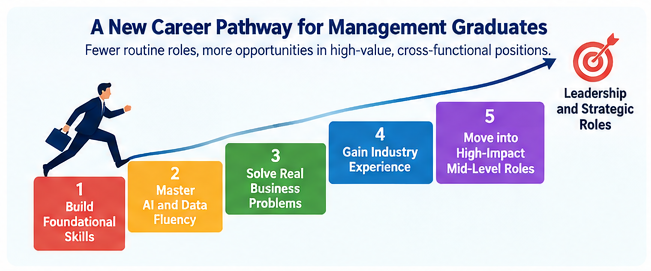
A future-ready MBA or PGDM programme must integrate five dimensions of competence. The first is functional depth. Students must understand finance, marketing, operations, strategy, human resources, and the economic logic of business decisions. The second is AI and digital fluency. Students must know how to use AI tools, analyse data, automate appropriate workflows, validate outputs, and recognise limitations.
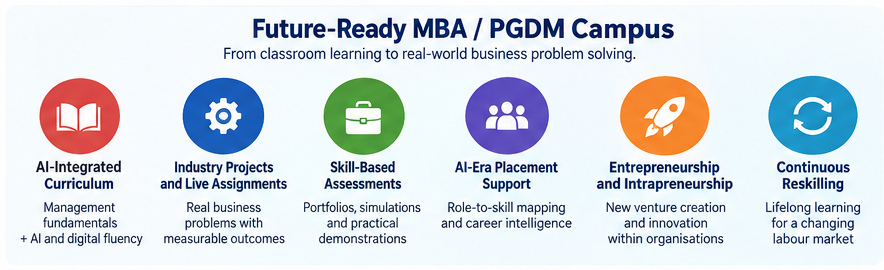
The third is commercial judgement. Students must understand costs, margins, revenue, customer behaviour, working capital, productivity, and risk. The fourth is execution capability. Students must be able to implement projects, manage stakeholders, resolve operational problems, and deliver results within constraints.
The fifth is human effectiveness. Students must communicate clearly, negotiate, collaborate, lead teams, handle ambiguity, and make responsible decisions. These five dimensions should not become five separate certificates. They should be integrated into the way every management discipline is taught.
For example, a finance assignment should require students to use AI for initial analysis, independently verify assumptions, identify risks, and defend a recommendation before a review panel. A marketing project should require students to interpret customer evidence, use AI to develop campaign alternatives, test the economics of those alternatives, and explain their strategic choice.
An operations assignment should require students to identify a process bottleneck, evaluate automation opportunities, calculate expected returns, and design controls for failures or exceptions. The purpose is to move students from knowing about management to demonstrating the ability to manage.
8. Campus transformation must begin with the employment model
The most important institutional change is to stop designing education exclusively around existing job descriptions. Traditional placement preparation often begins by identifying the roles companies recruit for and then training students to qualify for those roles. This approach is necessary but insufficient when job descriptions, team structures, and hiring criteria are changing rapidly.
Management institutions must also identify the enduring business problems that organisations will continue to face. Companies will still need to acquire customers, control costs, allocate capital, manage suppliers, retain talent, improve productivity, comply with regulations, develop products, and manage risk. The tools used to solve these problems may change dramatically, but the problems themselves will remain.
A future-ready campus should therefore organise learning around business problems and measurable outcomes. Instead of asking only whether a student is ready for a marketing executive position, the institution should also ask whether that student can improve customer acquisition economics, analyse campaign profitability, identify a weak sales funnel, and recommend a better allocation of resources.
Instead of asking only whether a student is ready for a procurement analyst position, the institution should assess whether the student can evaluate suppliers, identify cost-saving opportunities, analyse supply risks, and design a more efficient purchasing process.
This change creates a broader employment pathway. Students become capable of applying for conventional positions while also demonstrating readiness for newly emerging roles and cross-functional assignments.
9. A practical campus blueprint for MBA and PGDM students
The following interventions can convert the AI diamond hypothesis into a concrete educational programme.
A. Establish an AI-enabled management laboratory
B. Introduce industry-based automation projects
C. Build a business problem portfolio for every student
D. Replace some conventional internships with supervised business assignments
E. Create an AI-era career and placement office
F. Teach AI governance and professional accountability
G. Develop entrepreneurial and intrapreneurial capabilities
H. Introduce a continuous reskilling system
10. How should institutions measure success?
If management education is changing, institutional performance measures must change as well. Placement percentages and salary packages will remain important, but they should be complemented by indicators that measure the quality and durability of employability.
Institutions should track the proportion of students who can independently demonstrate AI-enabled business skills, the number of industry projects completed, the quality of employer assessments, the proportion of graduates placed in roles aligned with their capabilities, and the progression of graduates into more responsible positions.
They should also measure the time required for graduates to become productive in their first jobs, employer satisfaction with their practical skills, and the effectiveness of alumni reskilling programmes. A particularly useful measure would be the business value of student projects, assessed through verified savings, improved process performance, better customer outcomes, or credible implementation plans.
Institutions must avoid claiming that projected savings are realised savings or that participation in an AI course automatically creates employability. The objective is to measure demonstrated competence and real-world impact. Over time, these measures could help institutions identify which interventions produce stronger employment outcomes and which need redesign.
11. The social responsibility of management education
The AI transition also raises a question that cannot be answered through curriculum design alone. If organisations produce more output with fewer workers, the distribution of productivity gains becomes a major economic and social issue.
Higher productivity can support lower prices, business expansion, new investment, higher wages, and the creation of new products and services. But these outcomes are not automatic. If productivity gains are concentrated while employment opportunities and bargaining power weaken for some groups, economic insecurity may rise even as corporate efficiency improves.
Management education must prepare future leaders to understand this tension. Students should examine how organisations can redesign jobs, retrain employees, redeploy talent, create new services, improve working conditions, and share the benefits of productivity responsibly.
The manager of the future should understand not only how to reduce the cost of a process but also how to manage the human consequences of that decision. For India, this challenge is especially important. The country needs productivity growth, competitive enterprises, quality employment, and opportunities for a large and diverse workforce. Automation policy and management practice should therefore aim to increase the economy’s capacity to create new work, rather than focus exclusively on eliminating existing tasks.
The objective is not to resist technology. It is to ensure that technological progress contributes to broader economic opportunity.
The future belongs to those who can turn intelligence into impact
Artificial intelligence is challenging the traditional relationship between education and employment. The old corporate model rewarded the ability to perform routine tasks accurately, accumulate experience, and gradually move up a well-defined hierarchy. The emerging model may reward a different combination of capabilities, including AI fluency, domain expertise, commercial judgement, problem-solving, collaboration, and accountability.
The corporate pyramid may evolve towards a diamond-like structure in some organisations, but the more fundamental change is the declining value of routine execution relative to the ability to design, interpret, coordinate, and improve business systems.
This has profound implications for MBA and PGDM institutions. They cannot guarantee that every graduate will enter a particular job category, nor should they attempt to preserve an outdated employment model. They must instead prepare students to navigate changing roles, compete for emerging opportunities, and create value across different organisational structures.
The campus of the future should become a laboratory for solving business problems, a platform for mastering AI-enabled work, a centre for developing managerial judgement, and a bridge between education and the changing requirements of industry.
The ultimate question is no longer whether a management graduate knows finance, marketing, operations, or human resources. It is whether the graduate can combine that knowledge with technology, human insight, and commercial understanding to make an organisation perform better.
In the age of AI, the winning manager will not be the person who competes with a machine at repetitive execution. It will be the person who knows what should be automated, what must remain a human responsibility, and how to turn the combined capabilities of people and intelligent systems into sustainable business value.
The future of management education must therefore move beyond preparing students for jobs as they exist today. It must prepare them for the work that organisations will need tomorrow.
