Lets know how timely credit support can protect enterprises, jobs and supply chains while strengthening India’s path towards Viksit Bharat.
India’s economic ambition is no longer defined only by how rapidly the economy grows, but increasingly by how resilient that growth remains when the global environment becomes uncertain.
Geopolitical tensions, disruptions in shipping routes, volatile energy prices, supply-chain interruptions and sudden changes in global demand can transmit shocks rapidly into the balance sheets of Indian businesses. For a large company, a temporary liquidity squeeze may be manageable. For a small manufacturer, exporter, logistics operator or service enterprise, the same shock can threaten payrolls, inventories, supplier payments and ultimately the survival of the business. This is where the Emergency Credit Line Guarantee Scheme (ECLGS) 5.0 assumes significance.
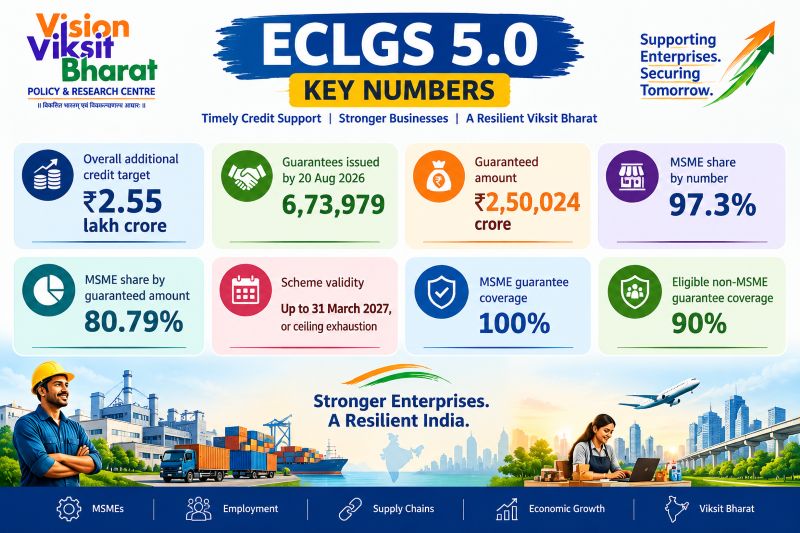
Approved by the Union Cabinet on 5 May 2026, ECLGS 5.0 is designed to provide additional credit to eligible businesses facing short-term liquidity pressures arising from external disruptions. Implemented through the National Credit Guarantee Trustee Company (NCGTC), the scheme seeks to reduce the risk borne by lending institutions and facilitate additional working-capital finance. Its overall target is up to ₹2.55 lakh crore of additional credit flow, including ₹5,000 crore earmarked for airlines. The deeper policy significance is larger than the headline number.
ECLGS 5.0 represents a shift from crisis management towards institutionalised economic resilience. It recognises that maintaining productive capacity during a shock can be as important as stimulating new investment during normal times.
Why business resilience matters for Viksit Bharat
The vision of Viksit Bharat requires India to sustain high economic growth while expanding productive capacity, employment, exports, entrepreneurship and technological capability. That objective depends heavily on the ability of India’s enterprises to withstand temporary disruptions.
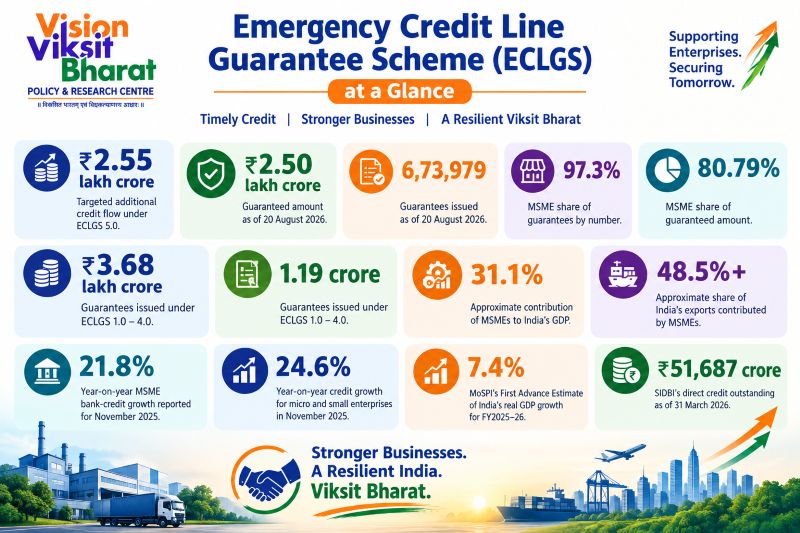
The MSME sector is particularly important in this equation. According to the Ministry of MSME Annual Report 2025–26, MSMEs contribute around 31.1% of India’s GDP and more than 48.5% of India’s exports. This means that an interruption at the enterprise level can become a macroeconomic problem.
A manufacturer unable to finance raw materials may reduce production. A logistics company facing a temporary cash-flow gap may reduce fleet utilisation. An exporter facing delayed receivables may struggle to pay workers and suppliers. A small services firm may postpone hiring or investment.
The chain reaction can look like:
External shock → liquidity pressure → reduced production → delayed payments → employment pressure → supply-chain disruption → slower growth
Timely credit can interrupt this chain. That is the central economic logic behind ECLGS 5.0.
From pandemic emergency to resilience architecture
ECLGS was originally introduced in 2020 under the Aatmanirbhar Bharat package, when the COVID-19 pandemic created an unprecedented interruption to economic activity.
The original policy problem was straightforward: otherwise viable businesses were facing an extraordinary temporary shock, but lenders were understandably reluctant to expand exposure when uncertainty and default risks were elevated.
The government therefore used credit guarantees as a risk-sharing mechanism.
Rather than directly lending to every affected business, the government enabled financial institutions to lend by providing guarantee support against specified credit risk.
The architecture subsequently evolved:
| Phase | Broad policy objective |
|---|---|
| ECLGS 1.0 | Support MSMEs, business enterprises, Mudra borrowers and individual business loans affected by COVID-19 |
| ECLGS 2.0 | Extend support to larger borrowers in stressed sectors and healthcare |
| ECLGS 3.0 | Support hospitality, travel, tourism, leisure, sporting and civil aviation sectors |
| ECLGS 4.0 | Strengthen healthcare infrastructure and oxygen-related capacity |
| ECLGS 5.0 | Provide targeted liquidity support against new external economic and geopolitical disruptions |
The cumulative scale of the earlier programme provides important evidence of the role of credit guarantees in a crisis. By the end of the earlier phases, 1.19 crore guarantees amounting to approximately ₹3.68 lakh crore had been issued. The schemes concluded on 31 March 2023.
An earlier government assessment also cited an SBI research finding that approximately 14.6 lakh MSME accounts were saved from distress, including restructured accounts, with about 98.3% belonging to micro and small enterprises. Another estimate indicated that around ₹2.2 lakh crore of MSME loan accounts improved, equivalent to roughly 12% of outstanding MSME credit being protected from slipping into NPA classification.
These figures illustrate an important lesson:
A credit guarantee can have an economic multiplier effect because it protects not only the borrower, but also the lender, employees, suppliers and the wider production ecosystem.
ECLGS 5.0: What has changed?
ECLGS 5.0 has been designed specifically around the liquidity challenges generated by external disruptions.
The scheme is available until 31 March 2027, or until the ₹2.55 lakh crore guarantee limit is reached, whichever occurs earlier. It covers eligible MSMEs, non-MSME business borrowers and scheduled passenger airlines.
For MSMEs and eligible non-MSMEs:
- Eligible borrowers must have existing working-capital facilities as of 31 March 2026.
- Repayments should not have been overdue by more than 60 days under the prescribed conditions.
- MSMEs across sectors are eligible subject to the scheme’s requirements.
- Certain sectors are excluded for eligible non-MSME borrowers.
- Eligible MSMEs receive 100% guarantee coverage, while eligible non-MSMEs receive 90% coverage.
- Additional credit can generally reach 20% of peak fund-based working-capital outstanding during Q4 FY2025–26, subject to a ₹100 crore ceiling per borrower.
- The scheme provides regulated pricing parameters, with the rate for eligible MSME loans linked to EBLR and eligible non-MSME loans linked to MCLR, subject to prescribed ceilings.
- The standard loan tenure is five years, including a one-year moratorium.
For scheduled passenger airlines, the structure is different because of the scale and capital intensity of the industry. Eligible airlines can receive additional credit of up to 100%, subject to a ₹1,500 crore ceiling per borrower, with additional equity requirements for amounts above ₹1,000 crore. The tenure can extend to seven years, including a two-year moratorium.
This sectoral differentiation is significant. It demonstrates that ECLGS 5.0 is not simply a one-size-fits-all credit programme. It attempts to match the financing mechanism with the scale and nature of the shock.
The speed of implementation is itself a policy achievement
The strongest evidence of early adoption comes from the programme’s actual utilisation.
As of 20 August 2026, ECLGS 5.0 had issued 6,73,979 guarantees, covering a guaranteed amount of ₹2,50,024 crore. MSMEs represented 97.3% of guarantees by number and 80.79% by guaranteed amount. This is remarkable when viewed against the programme’s overall ceiling.
The pace is particularly notable because the scheme was approved only in May 2026.
By July 2026, the government had already reported 4,11,497 guarantees worth ₹1,55,229 crore, with around 98% of guarantees by number benefiting MSMEs. The subsequent increase to ₹2.50 lakh crore by 20 August indicates how rapidly the facility was absorbed.
Why MSMEs are at the centre of the strategy
The concentration of ECLGS 5.0 support among MSMEs is economically logical. MSMEs frequently operate with thinner liquidity buffers than large corporations. Their access to capital markets is limited, and working-capital finance from banks and NBFCs can be critical for inventory, wages, receivables and supplier payments.
The broader credit environment also demonstrates strong demand. The Economic Survey 2025–26 reported that bank credit to the MSME sector increased 21.8% year-on-year in November 2025, compared with 13% a year earlier. Credit to micro and small enterprises grew even faster, at 24.6% year-on-year.
RBI data show that outstanding scheduled-commercial-bank credit to MSMEs increased from approximately ₹27.3 lakh crore in FY2023–24 to ₹31.3 lakh crore in FY2024–25, while the number of MSME credit accounts remained in the hundreds of lakhs. ECLGS therefore does not operate in isolation. It is part of a broader movement towards deeper institutional credit penetration among India’s smaller enterprises.
From collateral constraints to risk-sharing
One of the most important features of the guarantee model is that it changes the risk equation for lenders.
In conventional lending, a bank must evaluate:
Probability of default × exposure × loss given default
During a systemic or external shock, perceived default probability can rise sharply even for businesses that were fundamentally viable before the disruption.
The result can be a classic credit-market problem:
Businesses need more liquidity precisely when lenders become more cautious.
Government-backed guarantees partially bridge this gap. By absorbing specified credit losses, the guarantee reduces the effective risk borne by the lending institution. This can encourage banks and financial institutions to maintain the flow of credit rather than respond to uncertainty with a broad withdrawal of financing.
The policy therefore works through a form of public-private risk sharing:
Government guarantee → lower lender risk → greater willingness to lend → enterprise liquidity → continued production → employment and supply-chain continuity
That is why ECLGS should not be viewed merely as a loan scheme. It is a financial-stability instrument aimed at preserving productive capacity.
Credit support as supply-chain policy
The impact of ECLGS extends beyond individual borrowers. Consider a manufacturing ecosystem. A small component manufacturer supplies a larger automobile company. That manufacturer purchases steel, electronics, packaging and logistics services from other firms. It also employs workers whose incomes support local consumption.
If the component manufacturer loses working capital because of an external disruption, the initial problem appears to be one firm’s financing. But the actual economic exposure can be much larger. A liquidity shock can move backwards and forwards through the supply chain.
This is why timely working-capital support can function as supply-chain insurance. For India, this has strategic importance. The country is seeking to expand its role in global manufacturing, electronics, pharmaceuticals, automobiles, defence production, textiles, food processing and other internationally integrated sectors. A resilient domestic supplier base is essential to that objective.
ECLGS 5.0 can therefore contribute to a broader national goal:
making Indian supply chains less vulnerable to temporary external shocks.
ECLGS 5.0 and the idea of strategic resilience
The nature of economic risk has changed. The COVID-19 pandemic demonstrated the consequences of a health emergency. The Russia–Ukraine conflict highlighted energy, commodity and food-security vulnerabilities. The disruptions associated with the West Asia situation have once again demonstrated how geopolitical events can influence transport, aviation, energy costs, trade routes and business liquidity.
For an increasingly globalised India, economic resilience cannot mean isolation from the global economy. It means having the financial, institutional and productive capacity to absorb shocks while remaining globally connected.
This is consistent with the broader emphasis of the Economic Survey 2025–26 on strategic resilience and strategic indispensability. The Survey notes that India’s growth potential has strengthened, the banking system is in good health and capital formation remains above 30% of GDP.
The implication is important:
A Viksit Bharat must be not only a larger economy, but a more shock-resistant economy.
Supporting employment without a direct employment subsidy
ECLGS does not operate primarily as an employment subsidy. Its employment effect is more indirect and potentially more durable.
A business that receives timely working capital can continue:
- paying employees;
- purchasing raw materials;
- servicing customers;
- fulfilling export orders;
- maintaining inventory;
- paying suppliers;
- operating machinery; and
- investing in recovery.
In this sense, credit continuity becomes employment continuity. This is especially important for MSMEs because their economic significance extends well beyond their direct contribution to GDP. The Ministry of MSME describes the sector as an important source of employment and entrepreneurship, particularly because it generates economic activity at comparatively lower capital intensity. Protecting the enterprise therefore protects the local economic ecosystem around it.
Digital delivery makes the programme more scalable
Another important dimension is the use of the Jan Samarth Portal and the wider digital financial infrastructure. Digital delivery can reduce information gaps between eligible borrowers and financial institutions, improve awareness and make government-supported credit easier to discover. ECLGS 5.0 has also been accompanied by structured outreach through State Level Bankers’ Committees, banks, NCGTC, PSB Alliance and industry organisations.
The first phase of outreach covered nine locations between 20 May and 6 June 2026, while a second phase is being conducted across additional locations. This matters because a credit guarantee has limited economic value if eligible enterprises do not know about it or cannot navigate the application process.
Policy design + financial infrastructure + digital access + outreach is what turns a guarantee ceiling into actual economic support.
ECLGS 5.0 and India’s broader credit transformation
ECLGS 5.0 arrives at a time when India’s financial system has become significantly more capable of supporting enterprise growth.
The Economic Survey reports that the flow of financial resources to the commercial sector increased from ₹13.6 lakh crore in FY2020 to ₹35.1 lakh crore in FY2025, representing a CAGR of approximately 20.9%. It further reported ₹30.8 lakh crore of such flows during April–December 2025, up 44.7% year-on-year.
Meanwhile, SIDBI has expanded its physical presence significantly. Government data show that SIDBI opened 71 new branches between April 2024 and July 2026, while its direct credit portfolio reached ₹51,687 crore as of 31 March 2026, up 36.8% from ₹37,781 crore a year earlier.
These developments matter because resilience requires more than one emergency scheme. It requires a financial ecosystem capable of continuously connecting enterprises with formal capital.
The macroeconomic context is favourable—but resilience remains necessary
India’s economy entered this period from a position of relative strength. MoSPI’s First Advance Estimates for FY2025–26 projected real GDP growth of 7.4%, compared with 6.5% in FY2024–25. The Economic Survey also described India’s banking system as healthy, with healthy credit intermediation and a strong underlying growth outlook.
This is precisely why targeted credit guarantees can be effective. The objective is not to replace normal market-based credit. It is to prevent an otherwise temporary external shock from permanently damaging productive enterprises. That distinction is fundamental.
Good crisis policy should be temporary and targeted while normal market financing remains the dominant mechanism.
The policy lesson: liquidity can be cheaper than reconstruction
There is a deeper economic principle behind ECLGS 5.0. When a viable business fails because of a temporary liquidity shock, restarting that business later may be significantly more expensive than keeping it operational during the disruption.
Once a firm closes:
- workers may leave;
- customers may move to competitors;
- suppliers may lose confidence;
- machinery may become underutilised;
- export relationships may be lost;
- working capital cycles may collapse; and
- lenders may classify accounts as stressed.
Rebuilding that productive capacity can take years. Providing temporary liquidity can be considerably less costly. Therefore, the policy objective should not be framed simply as “providing loans to businesses.”
It is more accurately described as:
preserving productive capacity until normal economic conditions return.
What ECLGS 5.0 means for Viksit Bharat
The Viksit Bharat vision rests on several mutually reinforcing pillars:
1. Productive enterprises: India needs millions of enterprises capable of producing competitively for domestic and international markets.
2. Employment: Enterprise continuity supports livelihoods and broad-based income generation.
3. Manufacturing and supply chains: Resilient suppliers are essential to India’s industrial ambitions.
4. Financial inclusion: Smaller businesses must increasingly participate in formal institutional credit.
5. Export competitiveness: Businesses need the ability to withstand temporary volatility in global markets.
6. Strategic resilience: India must be able to absorb external shocks without losing its growth trajectory.
ECLGS 5.0 intersects with all six.
Its importance therefore lies not merely in the ₹2.55 lakh crore headline allocation. Its significance lies in how that credit can prevent temporary disruptions from becoming permanent economic scarring.
The road ahead: from emergency credit to permanent resilience
ECLGS 5.0 also raises several policy questions for the future. First, India should continue strengthening real-time credit assessment using verified digital business data. Second, government guarantee programmes should increasingly be linked with early-warning systems that identify temporary liquidity stress before it becomes insolvency.
Third, MSMEs should receive greater support for financial risk management, including receivables management, insurance, supply-chain diversification and export-risk management. Fourth, credit support should be accompanied by measures that improve enterprise productivity—technology adoption, quality certification, digitalisation, skilling and market access.
Fifth, policymakers should systematically evaluate the scheme not only through the amount of credit guaranteed, but through outcomes such as:
- enterprises surviving shocks;
- jobs retained;
- NPAs avoided;
- production maintained;
- exports protected;
- tax revenues preserved;
- supply chains sustained; and
- subsequent private investment generated.
This would transform ECLGS from an emergency intervention into a source of policy learning for future resilience programmes.
Building a stronger economy by protecting its productive core
India’s economic transformation will not be a straight line. External shocks will continue to emerge—from geopolitics and commodity prices to climate events, global financial conditions, supply-chain disruptions and changes in international demand.
The critical question is not whether India can avoid every shock.It is whether India can absorb those shocks without losing its development momentum. ECLGS 5.0 is an important instrument in that effort.
Its early performance—6.74 lakh guarantees covering ₹2.50 lakh crore by 20 August 2026—demonstrates substantial demand for targeted liquidity support. With MSMEs accounting for 97.3% of guarantees by number, the programme is reaching the segment that sits at the heart of India’s entrepreneurial and supply-chain ecosystem.
The larger lesson is clear. Resilience is a form of economic infrastructure. Roads, ports, power networks and digital systems enable businesses to operate. A resilient financial system ensures that those businesses can continue operating when unexpected shocks occur.
For Viksit Bharat, that resilience will matter enormously. A developed India cannot simply aspire to produce more. It must be capable of protecting productive capacity, sustaining employment, preserving supply chains, expanding formal credit and recovering rapidly from disruption. ECLGS 5.0 contributes to that architecture by putting timely credit behind a simple but powerful economic principle:
When a temporary shock threatens a viable enterprise, protecting liquidity today can protect growth tomorrow.
That is the essence of Strengthening Business Resilience through Timely Credit Support—and an important building block in India’s journey towards a more resilient, competitive and Viksit Bharat.
