Book Review by Neelabh Kumar Sharma
Indian civilisation has never been merely a witness to history; it has been a source of knowledge, intellectual inquiry and innovative thought for thousands of years. From mathematics and astronomy to medicine, philosophy, linguistics, literature and the performing arts, Bharat’s knowledge traditions reflect a civilisational legacy that continues to offer insights for the contemporary world. The challenge today is not simply to celebrate this heritage, but to understand it systematically, examine it critically and explore its relevance to modern education, research and nation-building.
At a time when India is working towards Viksit Bharat, the revival and integration of Indian Knowledge Systems (IKS) into mainstream education assumes renewed significance. The National Education Policy 2020 has created an important framework for bringing India’s intellectual traditions into contemporary learning. However, meaningful integration requires more than policy recognition. It demands accessible academic resources that introduce young learners to the foundations, diversity and methodologies of Indian knowledge traditions.
Book, Indian Knowledge Systems: A Primer, seeks to address this need by encouraging students to discover their civilisational inheritance through a structured and engaging introduction to IKS. Written by Prof. Gautam R. Desiraju, Anshuman Panda and Deekshit Bhattacharya, and published by Khanna Publishers, Delhi, with support from the IKS Division, Ministry of Education, this introductory textbook arrives at a significant moment in Indian higher education.
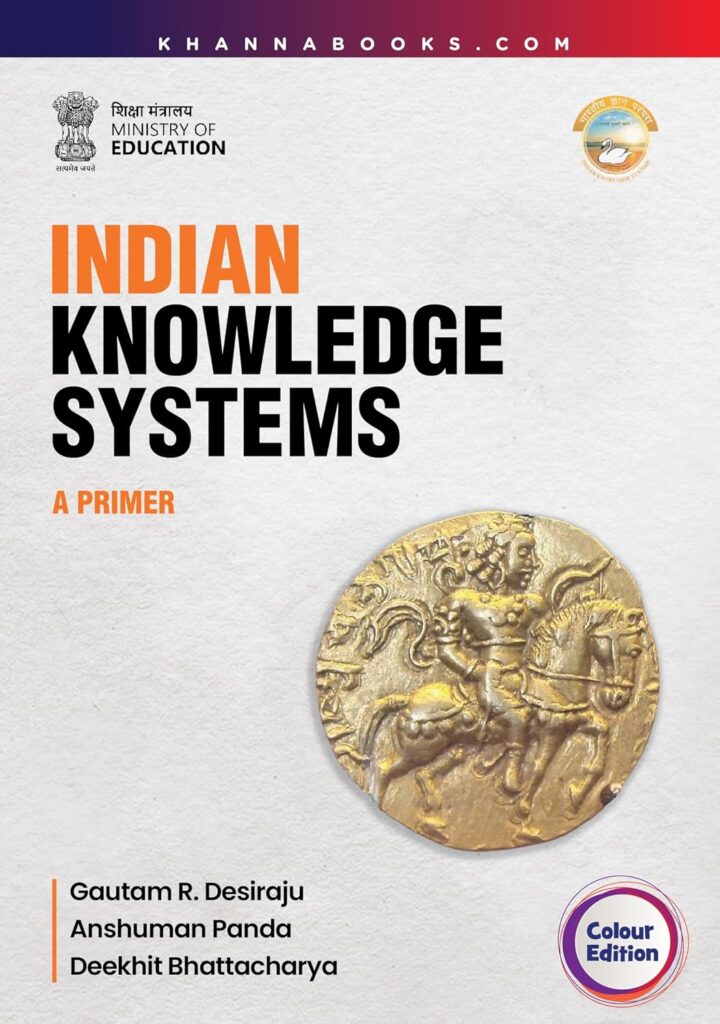
Its purpose extends beyond presenting historical achievements. It seeks to stimulate curiosity among students at the threshold between school and college, inviting them to explore how India’s knowledge traditions developed, how they shaped its intellectual and social life, and how they might inspire new avenues of inquiry in the present.
Ultimately, the book raises an important question for contemporary India: how can a civilisation with a rich intellectual inheritance draw meaningfully upon its knowledge traditions while addressing the demands of modern education, scientific inquiry and national development? By encouraging students to ask questions rather than merely accept conclusions, Indian Knowledge Systems: A Primer opens a conversation about the relationship between civilisational continuity and contemporary progress. This conversation is closely connected to the broader vision of Viksit Bharat 2047, in which India’s development can draw strength from both modern innovation and a deeper understanding of its own intellectual heritage.
The publication also arrives amid an ongoing public debate on IKS in education, with questions raised across ideological lines about its necessity and scope. Rather than entering this debate polemically, the book responds through scholarship: accessible, evidence-based, and pedagogically engaging rather than ideologically assertive.
This, in fact, is the book’s larger purpose: the decolonisation of education. The idea is often misunderstood. Decolonisation does not mean rejecting Western scholarship or advocating isolation; it means freeing ourselves from the colonial lens that conditions Indians to see their own civilization as inferior. Ngũgĩ wa Thiong’o’s Decolonising the Mind describes exactly this condition. Indian students learn the Pythagorean theorem but not the geometry of the Śulba Sūtras; they study Aristotle before Gautama, Descartes before Nyāya, Newton before Āryabhata. The book does not seek to reverse these priorities but to restore balance, letting students appreciate Indian epistemology on its own terms.
Few are better placed to lead such a project than Prof. Desiraju, an internationally renowned crystallographer, Emeritus Professor at IISc Bengaluru, and Dean of SAStech at Rishihood University, who bridges scientific inquiry and Indian civilizational thought with rare ease. Together with Panda and Bhattacharya, he has produced a book meant to inculcate curiosity and intellectual confidence rather than merely transmit information.
As its title suggests, the book is a primer: a gateway, not an encyclopaedia. IKS spans literature, philosophy, science, medicine, governance, aesthetics, and more, so an introductory text must orient rather than exhaust its subject, and the authors stay conscious of this throughout. The design reflects this ambition: each page runs in two columns, with the main narrative on the left and illustrations, anecdotes, maps, timelines, QR codes, and audio-video links on the right, turning a textbook into something closer to an interactive resource.
Structurally, the book unfolds across five chapters: “What is Indian?”, “What is Knowledge?”, “What is Systems?”, “What is IKS?”, and “Bhāratiya Civilizational Reawakening”, a sequence that itself mirrors Indian epistemology, building understanding through successive questions rather than upfront definitions. The opening chapter sets the tone with a striking line: the authors will ask readers questions and leave them to figure out the answers, echoing the dialogical spirit of the Upanishads and Nyāya. The second chapter introduces the Chaturdasha Vidyāsthānas (the fourteen traditional branches of learning), along with Śruti and Smṛti, showing how colonial disruption severed India from this intellectual tradition. The third, perhaps the book’s most original chapter, distinguishes complicated from complex systems and reductionism from emergence, arguing that IKS complements rather than replaces Western scientific method, resisting easy binaries between “Indian” and “Western” knowledge. The fourth uses the metaphor of the banyan tree and the Panchakośas to present IKS holistically, drawing on figures like Kalam, Sarojini Naidu, and Dharampal to show its continuing relevance. The final chapter situates all this within Bhāratiya Civilizational Reawakening, arguing that Bhārat is best understood as a civilization organised around Dharma, and closes with a call for readers to join this process themselves.
The book’s language is one of its finest strengths: simple without being simplistic, explaining difficult philosophical ideas through everyday examples. Its liberal use of illustrations, tables, timelines, and QR codes linking to music, recitations, and documentaries reflects real thought about how students learn today.
Equally important is what the book does not do. It does not dismiss Western knowledge; the authors acknowledge its strengths in practical application while arguing that IKS offers something equally valuable: a civilizational perspective, or dṛṣṭi, enabling integrated thinking across domains. This is perhaps its most significant contribution: not replacing one knowledge system with another, but opening a dialogue between them.
No introductory book can, or should, answer every question about IKS; an ocean of knowledge accumulated over millennia cannot be compressed into 192 pages, and the authors know this. The book’s value lies precisely in acknowledging its limits: it offers not final answers but better questions.
Ultimately, Indian Knowledge Systems: A Primer succeeds because it understands what a primer should do: not an encyclopaedia, but an invitation. It makes the case for India’s knowledge traditions through evidence and inquiry rather than rhetoric, reminding readers of India’s contributions to mathematics, metallurgy, philosophy, medicine, music, and governance, while encouraging students to see themselves not just as inheritors of this civilization but as its future custodians. Parents of children entering high school or college, teachers introducing IKS, and curious readers alike will find in this book a timely, thoughtful, and much-needed point of departure.
You may purchase the book on Amazon: Click Here
(Neelabh Kumar Sharma is an Assistant Director (Research & Admin), Centre for Human Sciences, Rishihood University, Sonipat. Views expressed are personal.)
