The birth anniversary of Sir Mokshagundam Visvesvaraya, celebrated every year on 15 September as Engineers’ Day, is generally marked as a tribute to one of India’s greatest engineers. Yet, reducing Visvesvaraya to his engineering achievements alone would be to miss the larger significance of his life. He was not merely an engineer who designed water systems, dams and flood-control mechanisms; he was a nation builder who understood that technology, infrastructure, education, industry and institutional capacity had to work together to transform an economy. His life offers an important framework for understanding a question that is central to India’s contemporary development journey: how does a nation move from development to developed-nation status? The answer, in Visvesvaraya’s thinking, lay in creating productive capacity rather than merely addressing immediate needs.
Visvesvaraya understood that agricultural prosperity alone could not create a modern economy. India needed industry, capital, skills, institutions and technology.
Born on 15 September 1860 at Muddenahalli, Visvesvaraya began his professional career as a civil engineer and went on to make pioneering contributions to irrigation, water supply, drainage, flood management and infrastructure. His automatic water-control gates, work on water systems and contribution to major irrigation projects demonstrated an unusual ability to combine scientific knowledge with practical problem-solving. But his contribution became much larger when he moved from engineering projects to questions of economic and institutional development. The Government of India has described him as a pioneering engineer whose work extended into industrialisation, technical education and nation building.
An Engineer Who Saw Beyond Engineering
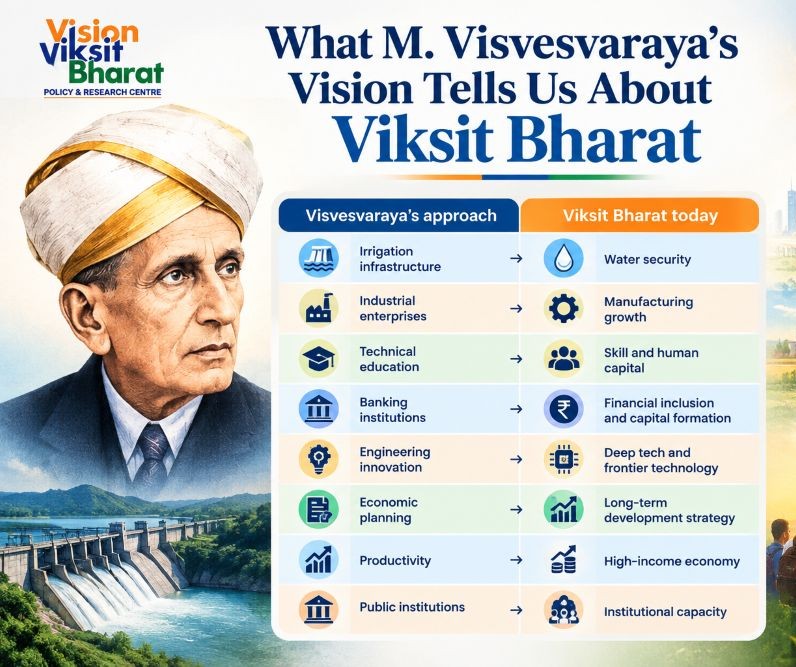
The most important aspect of Visvesvaraya’s legacy is that he did not see engineering as an isolated technical profession. For him, engineering was an instrument of economic transformation. A reservoir was not simply a structure for storing water; it could increase agricultural productivity, support cities, generate economic activity and create the foundation for industrial growth. A factory was not merely a place of production; it could develop skills, generate employment, build domestic capabilities and reduce economic dependence. An educational institution was not simply a centre of learning; it was an investment in the human capital required by a modern economy.
This systems-oriented thinking makes Visvesvaraya particularly relevant to the idea of Viksit Bharat@2047. India’s development challenge today is also no longer about constructing individual assets in isolation. It is about creating interconnected systems of infrastructure, technology, skills, manufacturing, innovation and institutions that can raise national productivity. In that sense, Visvesvaraya’s contribution offers a remarkably contemporary proposition: the real purpose of engineering is not merely to build things, but to build the productive capabilities of a nation.
Water Infrastructure as an Engine of Development
Visvesvaraya’s work in water management provides perhaps the clearest illustration of this philosophy. His expertise covered irrigation, reservoirs, dams, drainage and drinking-water systems. He patented an automatic system of weir floodgates, first installed at Khadakvasla near Pune, designed to regulate water levels and reduce wasteful overflow. His engineering work subsequently extended to major water and flood-management challenges, including the Krishna Raja Sagara project in Mysore and flood-protection measures following the devastating 1908 Musi floods in Hyderabad. Government sources recognise these contributions as important milestones in India’s early water-management and engineering history.
The significance of these projects goes beyond engineering history. Water is one of the foundations of economic productivity. Reliable irrigation can raise agricultural output; urban water systems support industrialisation and healthier cities; flood management protects economic assets; and efficient water utilisation becomes increasingly important in an era of climate variability. Visvesvaraya’s approach therefore has direct relevance to contemporary India, where water security must increasingly be understood not only as a social requirement but also as an economic and productivity imperative. His work reminds us that infrastructure becomes transformative when it multiplies the productive capacity of society.
Krishna Raja Sagara: From a Dam to a Development Model
The Krishna Raja Sagara Dam in Mysore represents this philosophy particularly well. The project was not conceived merely as a civil engineering accomplishment. Its wider significance lay in using water infrastructure to support agriculture, urban development and the economic transformation of the region. Modern government material continues to recognise Visvesvaraya’s role in pioneering water-management solutions and the wider developmental impact associated with the KRS project.
This provides an important lesson for Viksit Bharat. India’s infrastructure investments should increasingly be evaluated not only by the physical assets created but by the economic ecosystems they enable. A highway should connect production centres to markets. A railway should reduce logistics costs and expand economic opportunity. A digital network should create new businesses and improve public services. A water project should enhance agricultural and industrial productivity. The Visvesvaraya approach was fundamentally about this multiplier effect: infrastructure should create capability, and capability should create prosperity.
Industrialisation Was Central to His Vision
Perhaps the most striking part of Visvesvaraya’s thinking was his conviction that India could not become prosperous without industrialisation. As Dewan of Mysore between 1912 and 1918, he played a significant role in promoting industrial and institutional development. His tenure was associated with initiatives such as the Iron and Steel plant at Bhadravati, Mysore Soap Factory, State Bank of Mysore and the Mysore Chamber of Commerce. Government records have specifically highlighted his role in promoting industrialisation even before India’s Independence.
His thinking was remarkably clear: an economy could not become modern simply by increasing consumption or expanding administration. It needed productive enterprises, technological capability, capital, skilled manpower and institutions capable of supporting industrial growth. The famous expression associated with his industrial vision, “Industrialise or Perish,” captured the urgency he attached to building industrial capacity. The relevance of that thinking has only increased in an era in which supply-chain resilience, manufacturing competitiveness, technological sovereignty and high-quality employment have become central to national economic strategy.
The Visvesvaraya Model of Atmanirbhar Development
There is an important distinction between self-reliance and isolation. Visvesvaraya’s approach was not about rejecting modern technology or global knowledge. It was about developing the domestic capability to use knowledge, technology and capital for India’s own economic advancement. His work at Bhadravati illustrates this orientation. Government science and technology material notes his effort to develop steel production using locally available resources and innovative methods.
This principle has direct relevance to today’s Atmanirbhar Bharat within the larger Viksit Bharat framework. A self-reliant India cannot mean producing everything domestically regardless of economic logic. It means possessing sufficient technological, manufacturing and institutional capability to remain competitive, resilient and strategically secure. The contemporary objective should therefore be to move from being a large market to becoming a global production, innovation and technology hub. In that sense, Visvesvaraya’s industrial vision can be read as an early Indian articulation of capability-based economic development.
Building Human Capital Alongside Physical Capital
Visvesvaraya’s vision also extended beyond factories and infrastructure. He understood that modernisation ultimately depends on people. His advocacy of technical education and institutional development reflected the belief that India required a trained workforce capable of operating and advancing a modern economy. Government sources have highlighted his support for technical education as well as educational initiatives during his tenure in Mysore.
This is perhaps even more relevant today. India’s demographic strength will translate into a development advantage only if it is converted into human capital. The next generation of engineers, scientists, researchers, entrepreneurs, technicians and technology professionals will determine whether India can move from technology adoption to technology creation. The Viksit Bharat vision therefore requires an education system that does more than produce degrees. It must produce capability, curiosity, innovation, research and problem-solving capacity. The Visvesvaraya model reminds us that physical infrastructure without human capital cannot sustain a developed economy.
He Was Thinking About Economic Planning Before Independence
Visvesvaraya’s intellectual contribution is often overshadowed by his engineering achievements. Yet his writings reveal the breadth of his economic thinking. His 1934 work, Planned Economy for India, advocated a systematic approach to India’s economic development and emphasised industrialisation and productive capacity. His earlier work Reconstructing India similarly reflected his concern with the institutional and economic foundations required for national progress. Government publications continue to identify these works as important components of his development philosophy.
The significance of this intellectual legacy is that Visvesvaraya was thinking about India’s development as a long-term national project. He was not satisfied with incremental improvements within existing structures. He wanted India to raise productivity, expand industry, improve education and develop the capabilities associated with advanced economies. This long-term orientation has strong resonance with the Viksit Bharat@2047 framework, which similarly places India’s development within a multi-decade horizon rather than a short-term policy cycle.
From Visvesvaraya’s Mysore to India’s Viksit Bharat
The contemporary relevance of Visvesvaraya therefore lies not in mechanically reproducing the solutions of another era, but in understanding the principles behind them. His approach connected infrastructure with productivity, industry with employment, education with economic capability, technology with national development and institutions with long-term transformation. These connections remain fundamental to India’s journey towards becoming a developed economy.
The scale of India’s present opportunity, however, is vastly different. India today has a large domestic market, a globally competitive technology sector, an expanding manufacturing ecosystem, world-class digital public infrastructure and a growing scientific and innovation base. The challenge is to integrate these strengths into a coherent development architecture. The next generation of infrastructure must be intelligent and sustainable; manufacturing must become more technologically sophisticated; universities must become stronger centres of research; and Indian innovation must increasingly move from laboratories to global markets.
Engineering the Future
The most meaningful way to remember Visvesvaraya on his birth anniversary, therefore, is not simply to celebrate his achievements but to ask what his philosophy demands from India today. He belonged to a generation that had limited resources but possessed an extraordinary belief in the possibility of national transformation. He demonstrated that engineering could solve practical problems, but he also showed that the engineer’s responsibility could extend much further: towards productivity, institutions, industrialisation, education and national progress.
Prime Minister Narendra Modi, while paying tribute to Visvesvaraya on Engineers’ Day in 2025, specifically noted that engineers would continue to play a crucial role in the collective effort to build a Viksit Bharat. That connection is important because the India of 2047 will require millions of professionals who combine technical excellence with a larger understanding of national development. Engineers will be needed not only to design bridges and buildings, but also to work on artificial intelligence, semiconductors, clean energy, advanced manufacturing, water security, space technology, biotechnology, digital infrastructure and climate resilience.
Visvesvaraya’s greatest legacy, therefore, may not be any single dam, factory or engineering innovation. It is the idea that a nation can consciously build its own capabilities. His life demonstrated that engineering becomes nation building when knowledge is converted into infrastructure, infrastructure into productivity, productivity into industrial capacity and industrial capacity into broad-based prosperity. As India looks towards Viksit Bharat@2047, that remains a powerful proposition: India must not merely consume the technologies of the future; it must engineer the systems, institutions and capabilities that will create the future.
